|
2025. December
| H | K | S | C | P | S | V | 01 | 02 | 03 | 04 | 05 | 06 | 07 | 08 | 09 | 10 | 11 | 12 | 13 | 14 | 15 | 16 | 17 | 18 | 19 | 20 | 21 | 22 | 23 | 24 | 25 | 26 | 27 | 28 | 29 | 30 | 31 | 01 | 02 | 03 | 04 |
|
|
| | | |
|
| Az életben az jó játékos, aki a rossz leosztást is jól játsza meg! | | |
|
Vannak olyan pillanatok az életben amikor annyira hiányzik nekünk valaki, hogy ki szeretnénk őt szakítani az álmainkból és úgy igazából megszeretnénk ölelni!!!:) | | |
|
Msn:
Petraaa:petra0727@freemail.hu
Petrababa:kicsicsaj_93@hotmail.com | | |
|
„Ölelj át, hogy biztonságban tudjam magam,
Szoríts sokáig, de halld meg még a szavam.
Táncoló veszély, szakadék mélye vár,
De mi legyőzünk mindent, mert ketten vagyunk már!” | | |
|
„Amikor a boldogság egyik kapuja bezárul, egy másik kinyílik előttünk. Néha olyan sokáig nézzük a bezárt ajtót, hogy nem vesszük észre azt, amelyik kinyílt.” | | |
|
|
|
[Friss hozzászólások] [185-166] [165-146] [145-126] [125-106] [105-86] [85-66] [65-46] [45-26] [25-6] [5-1]
| szeretnék fosterék házás képeket/videókat látni a honlapon!!! |
| Ha erre jársz nézzd meg van új plety....:D:Dpzuszikkaaa |
| jah de legalább titeket látni fogunk mindennap ! |
Van egy nagyon rossz hírem!!Minnyá kezdödik a sulii!!:S:S
puszikaa
Petrababa |
Tényleg marha jóóó az oldal,csak így tovább ;);)
Rita :) |
| Ma voltak 1000-ren az oldalon!!!hurrá!!!!vagyis most!!!puszancs!!! |
Vannak új dolgok az oldalon Pl(Új pletyka,új szavazás)Mondjátok meg még miket szertnétek az oldalra???puszancss....
PetRák |
szijasztok
retenetesen jo az oldalatok télleg tetszik
puszi:Kata |
Na megint zuzok balcsira.....!!Hiányozni fogtok!!!Puszikaaa...(K)!!Legyet jók!!Ésírjatok ha már hiányzok!!!:P:P
U.I:Hétfön jövök!!!
Na mégegyszer PUSZIKAA!!
Petrababa:D
|
gaggggyik vagytoookk :):):):)))))) tudom kik vagytok XDXD
Petraaa:))) |
| A hadseregben a kerek dolgokat viszik, a Az életben az jó játékos, aki a rossz leosztást is jól játsza meg!szögleteseket gurítják. De csak azért, hogy lekopjanak az éleik, kerekek legyenek, és lehessen vinni őket.
8-)
Képek
Pletyi
Petraaa SzÁMLálÓ
Indulás: 2006.06.20.
Bölcseség =)
Az életben az jó játékos, aki a rossz leosztást is jól játsza meg!
SzAvAzÁs
Melyik a kedvenc figurád???
Snoopy
South Park emberkék...
Pimboli
Happy Tree Friends
Diddle16 tonna
1994
5 óra 30 perc
70 éves nimfomániás
70-es évek
A harag napja
A jó lovas
A Terror Pláza
A terrorista halála
A terrorista visszatér
A világ megokolt utálata
Agónia
Ájn, cváj, dráj
Álom 1.
Álom 2
Amerika 1 (Észak)
Amerika 2 (Dél)
Anarchia Albániában
Anarchista önvallomás
Árvácska
Átlag
Autonómia
Az én városom
Baranya
Barna Fizet
Barna fizet (sci-fi)
Béke van a Balkánon
Belfast
Benned vagyok baby
Bevándorló dal
Bevezető
Bíztató
Blitzkrieg Bop
Bocsánat
Botrányhős
Brutális majális
Bucimaci (Pojac-Punk)
Buktassuk meg
Commandante
Csak azt csinálom... (1. verzió)
Csak azt csinálom... (2. verzió)
Dollár, hatalom, pornó
Dr. Kátrány és Toll prof.
Drasztikus szerelem
Döntsd a tőkét!
Ebertelen nyár
Ébresztõ
Egy kurva, ha részeg
Egyvalag
Elment a barátom
Elvonó
Embertelen nyár
Felhőtlen ég
Felső 10. 000
Feminista
Football
Géprombolók
Globalhé
Gyalogtúra
Gyere buktassuk meg!
Hajrá Dózsa György!
Hangulatjelentés
Hannover
Hánynom kell
Hármas jelszó
Hátra arc!
Hazaváglak
Hé te!
Héják és galambok
Heterosex
Hétköznapi csalódások
Hiszek
Hivatalnok a pokolban
Homeless
Indul a gyár
Isten hozott nálunk, Johnny!
Istenjárás
Jól haladunk!
Kalózdal az almaborról
Karácsony a Magyar köztársaságban (Punk karácsony)
Karma
Kaukázusi krétakör
Kedvesem betegen
Kenderzsupp
Keresek valakit
Két hexameter / Végül
Két vers (K.S. † TBC-ben)
Kiégett föld
Kijózanító állomás
Kisgizda
Kitiltanak, betiltanak
Kokain és Heroin
Köpj le egy rendört
Kössük fel
Kösz Allen!
Kösz Attila!
Le vagyok győzve
Los Angeles 92
Magas szőke karvalytőke
Már semmi se fáj
Más kell!
Másnapos vagyok
Mecsekalján az élet
Meghalt K.J.
Menekülj!
Meztelenül, részegen
Mi nem tetszik?
Mi történik itt
Minden eladó
Mindenki jót akar
Most adjatok!
Műanyag Bertrand
Munkapunk
My fuck
Nagy a baj
Néha már
Néhány éjjelre, padra, kőre
Nemcsak a szélsőjobb oldalé a világ
New wave
Nyaljátok ki
Ó Európa
Obszcén regény
Oh, én szeretem õt
Olaj
Ólomidő
Ostoba
Prágai ősz
Punk Rock and Roll
Régi eset
Reklám
Reménytelenül (részlet) - Tiszta Szívvel
Rockkultúra
Ruandában meleg van
Rudolf Hess
Sárga füvek
Seggfej
Sorozatgyilkos - Brazil
Sorozatgyilkos - Szaros árnyak
Súgni kell
Szabad a pálya!
Szabad vagy!
Szabados dal
Szélsődal
Szemben a bordély ház
Szemet szemért
Szenvedek
Szép az ország
Szeresd a rendőrt!
Szerezz szeszt!
Szociális védőháló
Szokatlan a helyzet
Szovjetúnió
Szűz vagy Baby
Szülinapunk
Tankok helyett pankok
Target
Télapó visszatér
Tiszta Szívvel
Tízmillióan egy felé
Tolerancia
Trainspotting
Trainspotting
U.S. Army
Új Germinál
Utazó
Utolsó évek
Vakáció a Balkánon
Valamit innom kell
Valóságshow
Vegetáriánus
Viktor
Vonatlesők
Vörös front (L.Aragon - részlet)
Vörösök
Ünnep után (1989 emlékére)
Öngyilkos Rock n Roll
Hello Kitty & Chococat
Spongyabob
Szavazás állása
Lezárt szavazások
Kattints a képre a teljes mérethez!
Rossz a kép URL-címe!
BöLcSeSéG
Vannak olyan pillanatok az életben amikor annyira hiányzik nekünk valaki, hogy ki szeretnénk őt szakítani az álmainkból és úgy igazából megszeretnénk ölelni!!!:)
Édes:)
Happy Tree Friends
sZaVaZáS
Mi a kedvenc márkád?
Nike
Puma
Adidas
Eastpak
Converse
Tisza
Budmil
Szavazás állása
Lezárt szavazások
Cukhiii
Itt érhetsz el minket!!
Msn:
Petraaa:petra0727@freemail.hu
Petrababa:kicsicsaj_93@hotmail.com
Nagyon cuki!
Szerelem
Az életben az jó játékos, aki a rossz leosztást is jól játsza meg!Az életben az jó játékos, aki a rossz leosztást is jól játsza meg!„Az együttest Imre Norbert és Polgár Tamás alapította Szekszárdon, 1989 tavaszán, akkor még Anális Coitus néven. Később( 89 novemberében) csatlakozott Blazsó Péter basszusgitáros és Gerendai Attila, a Pink Panthers dobosa. Analis Coitus néven adták ki az első demójukat (olyan klasszikusokkal, mint a "Vörös hadsereg" vagy a "Karácsony"), de a "Szép az élet" már Prosectura néven jelent meg pár hónappal később. Városszerte nagy népszerűségnek örvendenek dallamos, Ramones-t idéző punkzenéjük és az utánozhatatlanul vicces szövegeiknek köszönhetően. Műfajukat pisikaki punknak nevezik egyik számukban, de ennél jóval több a Prosectura. Felületes hallgató talán valóban ennyiben maradna, de ha odafigyelünk a szövegekre, feltűnhet, hogy a sok, látszólag marhaságnak tűnő sor rengeteg iróniát, szarkazmust rejt, nem kímélve senkit és semmit.
1993 elejére az együttes már országosan ismert, egyre nő a közönség. 1994-ben végre CD-n is megjelenik új lemezük, ami akkoriban még nagy dolognak számított egy punkegyüttesnél, akiknek esélyük sincs arra, hogy egy nagykiadó egyengesse az útját. Sikeres lemezekkel és tagcserékkel övezett évek következnek, 1998-ban 8 éves születésnapjukat koncertlemezzel ünneplik.
Manapság a Prosectura több, mint punkzenekar, ott vannak minden rockfesztiválon, és középiskolás házibulik elmaradhatatlan kellékei a vidám dalok”
„Ölelj át, hogy biztonságban tudjam magam,
Szoríts sokáig, de halld meg még a szavam.
Táncoló veszély, szakadék mélye vár,
De mi legyőzünk mindent, mert ketten vagyunk már!”
Okosságok
A hadseregben a kerek dolgokat viszik, a szögleteseket gurítják. De csak azért, hogy lekopjanak az éleik, kerekek legyenek, és lehessen vinni őket.
CHAT
Név:
Üzenet:
:) :( :? :(( :o :)) ;) 8o 8p 8) 8|
Kedvenc Linkjeim
4everfoci
Kinga oldala
Atletico Madrid
Peet oldala
Kitty Yvett oldala
Martin és Bence oldala(Autós)
angyalipicsuszok
Pimboli....
Ezt fogadjátok meg!
"A szerelem nem egy,hanem egyetlen lehetöség,hogy boldogok legyünk."
(Francoise Sagan)
SzAvazÁS
Szavazzz!!!!!!
Milyen az oldal???????
Naggggyon tuti csak így tovább:):)
lehetne jobb is....
nem rossz!!
iszonyat szar...:S
aranyos:))))
Szavazás állása
Lezárt szavazások
Pimboli
Zene
Kattints a képre a teljes mérethez!
SzAvAzÁs
Szavazzzz!!
Mi a zenei ízlésed???:)
Rock
Punk
Pop
Rap
Disco
Reggae
Hip-Hop
Vegyes
Egyéb.....
Szavazás állása
Lezárt szavazások
Szomiii utánna boldog!!
Csalódás
„Amikor a boldogság egyik kapuja bezárul, egy másik kinyílik előttünk. Néha olyan sokáig nézzük a bezárt ajtót, hogy nem vesszük észre azt, amelyik kinyílt.”
Okosságok
A hadseregben a kerek dolgokat viszik, a szögleteseket gurítják. De csak azért, hogy lekopjanak az éleik, kerekek legyenek, és lehessen vinni őket.
CHAT
Név:
Üzenet:
BIOGRAPHY
In the last eight or so years, Children Of Bodom that darted to international fame with their debut, 1997’s "Something Wild", has gone from being "this amazing band from Finland" to a household name in the metalscene. And that, of course, is obvious given the intensity, sheer quality of their material and the flawless execution.
Formed in 1993 and hailing from the city of Espoo, Finland, this young Finnish group took their name from one of the biggest murder mysteries in the history of their home town and Finnish crime: the murders at the Lake Bodom. After starting out as a thrash-metal combo, the founding members Alexi Laiho (guitars and vocals), Jaska Raatikainen (drums), Henkka Seppälä (bass) and Alexander Kuoppala (guitars) soon found elements of classic heavy metal creeping into their music. After taking in keyboardist Janne Wirman to complete their line-up, they honed their combination of old schoold black metal, classic heavy, and death metal vocals into the sharpest instrument of its kind and headed out to a studio record a demo tape.
After Spinefarm Records received Children Of Bodom’s demo, it didn’t take long for the company to figure out what they had in their hands back in late 1996. Soon the band was signed and ready to knock a few heads off.
The self-titled debut single "Children Of Bodom" went straight to number 1 on the Finnish charts and sold platinum. The debut full-length album "Something Wild" was released in Finland in 1997. The Bodoms supported Dimmu Borgir at the band's Helsinki show in November and were hailed as the new kings of Finnish underground metal by the press. Licensing deal with Nuclear Blast for central Europe was inked quickly and soon after Middle Europe the album was also released in Japan and Thailand.
Soon Children Of Bodom was flying all over Europe and writing new material that would become the "Hatebreeder" album, which was released in February 1999. On "Hatebreeder" their music had found its true shape: the album was faster, heavier and more versatile than "Something Wild". The single "Downfall" went gold and ruled the Finnish charts.
During the summer 99 Children Of Bodom toured Finland and Europe. In June they did three sold out gigs in Japan with Dark Tranquillity and Sinergy and recorded the live CD: "Tokyo Warhearts-Live in Japan". "Tokyo Warhearts" came out as a limited digibook-edition in Europe in October and all the 20.000 copies of it were almost immediately sold out. The buzz around the band was reaching new heights.
In 2000 the single "Hate Me!" went #1 at the Finnish charts and sold gold in Finland in just a couple of weeks. Platinum sales soon followed. While the single was topping the charts, Children Of Bodom finished their studio sessions at Peter Tägtgren's Abyss Studio, and the third album "Follow the Reaper" saw the light of day on the 30th of October 2000.
"Follow the Reaper" was a glorious mixture of their debut album's heavy riffing raw sound, combined with "Hatebreeder" monstrous technical metal acrobatics. The most noticable thing however was how much the band had improved as a unit and in bringing the personal levels of musicianship to a new high.
On "Hate Crew Deathroll", which was released in January 2003, not only did the band take their songwriting into new levels of aggressivity and heaviness but the way the songs were carried out pummeled everything they -or anyone, for that matter- had done into dust.
On "Hate Crew Deathroll" Alexi Laiho spits out his lyrics with vitriolic hate, the guitars (courtesy of Alexi and Alexander Kuoppala) shred everything in their wake with razorsharp precision while the rhythmsection (the demolition duo of Henkka T. Blacksmith & Jaska W. Raatikainen) pounds away like the world is about to end. As a final coup de gracé come the keyboards of Janne Warman, making sure the path of destruction is complete with the fervour and precision of a seasoned executioner on a killing spree.
In the Summer of 2003, Alexander Kuoppala left the band and was replaced by Roope Latvala, whose stellar playing had already graced countless of Finnish metal records. Being perhaps the most widely acclaimed metal guitarist in Finland ever, Roope’s flexible playing style and strange sense of harmony was a strong influence on CoB by the way of his early nineties speed metal band Stone.
In 2004 the band tested their new line-up on a four-track EP and a separate DVD-EP "Trashed, Lost & Strungout" that gave a little taster of the future alongside with two great cover songs. The EP was an introduction to a new-found drive, a rougher edge, still sounding definitely and unmistakeably very CoB.
After the relase of the successful mini-album, Children of Bodom barricaded themselves into studio Hästholmen, Helsinki, to record their next full-length album together with producer / mixer / engineer guru Mikko Karmila. The result was "Are You Dead Yet?", title of which is merely rhetorical: the fourth studio album from the trailblazing Finnish metal hate crew is killer stuff throughout.
Children of Bodom have come a long way since their humble beginnings, and today stand tall in the all time extreme metal hall of fame, commanding the respect and awe of both fans and colleagues alike. Children of Bodom have been hugely influential, but still, eight years down the road east and west alike, remain the leaders of the genre. "Are You Dead Yet?" is all the proof you need.
:) :( :? :(( :o :)) ;) 8o 8p 8) 8|
Kedvenc Linkjeim
4everfoci
Kinga oldala
Atletico Madrid
Peet oldala
Kitty Yvett oldala
Martin és Bence oldala(Autós)
angyalipicsuszok
Vendégkönyv
Vendégkönyv : Új hozzászólás
Bejegyzés:
Súgó Súgó
kedvencei
Resting on laurels has never been an option for the men of Southern California’s punk rock powerhouse Pennywise. With The Fuse – an amazing, incendiary album from its first snare drum crack to its last molten guitar line – the legendary Hermosa Beach foursome plays with more tenacity and vigor than ever.
“We made a conscious effort to just go in and plug in and play and not over-analyze things as much as we have in the past,” frontman Jim Lindberg says of the band’s eighth studio set. “We made The Fuse in half the time of the last record and having that mindset going into it made us put more energy into our performances and gave the album more immediacy.”
Shooting off one sonic fireball after another, The Fuse – recorded with longtime co-conspirator Darian Rundall – just may be the best-sounding Pennywise record yet. From the scorching opening anthem, “Knocked Down” – which serves as a forum for the blistering riffs of guitarist Fletcher Dragge and Lindberg’s scowling attack on the sorry state of affairs in world politics – to the electrical shocker “Closer” and beyond, these Warped Tour icons come out swinging and don’t relent. If the latter is an urgent blast that chronicles the frustration elicited out of the daily struggles we all face in the search for happiness, it’s also an ideal platform for the thumping, fat-bottomed wares of bassist Randy Bradbury and drummer Byron McMackin.
Machine gun guitars ignite the furious “Yell Out,” a neck breaking, old school assault of the highest order that gives way to an equally inspired, full-throttle hardcore opus, “Competition Song.” Emphasizing Lindberg’s presence as one of modern day punk’s most distinct, forceful voices, The Fuse jolts punk aficionados like a surging KV line.
“Loud, hard and fast – it’s what we’re comfortable playing and we know that’s what people expect from us,” Lindberg says matter-of-factly. “With each record we just try and add subtle changes to the form without morphing into a completely different band, or worse, trying to keep up with the latest trends in music. I think the real challenge is to stay true to who you are and keep things interesting. We try and keep the songs and message timely and engaging within the style of music we’ve always played, and hopefully add to what we’ve already accomplished.”
With the determination to bring their game year after year, the members of Pennywise have made a career out of not merely embracing punk rock but playing it as if their lives depended on it. Although Lindberg will tell you there’s no big secret to outlasting a myriad of other groups to become one of the biggest sellers and most beloved acts on the Epitaph roster.
“It’s incredibly hard to get four guys to agree on where to go for dinner let alone agree on the million issues surrounding putting out a record, going on tour and how the band is presented,” the Pennywise singer admits. “We’ve always made sure we didn’t do so much that we became burned out. Sure we could have made more money if we toured nine months out of the year, but that’s not what we’re in it for and then we probably wouldn’t still be around. It can be difficult but I think at the base of it we’re all friends, and we know that there are people out there that appreciate what we do, so we try to put our arguments aside and give everything we can to the music.”
Formed in 1988 by Lindberg, Dragge, McMackin and original bassist Jason Thirsk, Pennywise aligned with Epitaph Records in time for their heralded, eponymous 1991 disc. In defiance of grunge, the disc helped to define the then-emerging West Coast punk movement. Astoundingly, 1993's Unknown Road sold a few hundred thousand copies and – rather typically – at the height of the punk resurgence of 1994 the major labels came calling. But the four-piece elected to stay put and released another Epitaph smash with ‘95’s About Time. When the tragic death of Thirsk the next year put the future of the collective in serious doubt, they rallied and regrouped with new bassist Randy Bradbury for Full Circle.
The popularity of Pennywise continued to swell as the 20th Century ended, first with the success of 1999's Straight Ahead, followed by the riotous 2000 concert disc Live at the Key Club and the group’s highly praised 2001 disc Land of the Free? An ensuing tour was highlighted by a sell-out gig at the 14,000-seat Long Beach Arena and while Jim, Fletcher, Byron and Randy took a year off for introspection, the group reemerged stronger than ever in 2003 as evidenced by the glowing accolades From The Ashes received. In early 2005, as Epitaph reissued remastered, content enhanced versions of the group’s first four albums, the band reconvened to craft what would ultimately become The Fuse.
According to Lindberg, much of the impetus for the lyrical direction of the new album came from recent headlines. “When we’re writing it’s all about trying to keep the energy and passion for what we’re doing alive and come up with material that keeps the band relevant,” he explains. “For me that means writing about things I feel strongly about. All I have to do is read the newspaper or watch the news every day and I get a never ending supply of subject matter.”
From the urban blight and unending cycle of violence that plagues our inner cities (“6th Avenue Nightmare”) to our cell phone-mad existence (“Disconnect”), and on to the tyrannical, power-drunk leaders in the world (“Premeditated Murder”) Pennywise emerges as apropos as ever on The Fuse. And perhaps most significant of all is the revulsion conveyed via “Fox TV.”
“That song came about just from watching shows like “Hannity and Colmes” and the documentary, “Outfoxed,” says Lindberg. It’s sad to think that the place where most of America gets its information about the world is from a shamelessly biased, tabloid-style news media outlet disguising itself as ‘fair and balanced’. Not only is it terrible for American Journalism, it’s bad for our country. I had to write a song about it before I went Elvis on my television.”
Created with their bullshit detectors on high, but housing an underlying sense of hope, The Fuse is more than an informed, logical rebuttal. It’s Pennywise at their best and set for detonation. Get the message or get out of the way, fuckers. Three years and eight months after the release of Toxicity, one of this decade’s most corrosively powerful, relevant and down-right important albums, System of a Down— guitarist/singer Daron Malakian, singer Serj Tankian, bass player Shavo Odadjian and drummer John Dolmayan—unleashes Mezmerize /Hypnotize… Well, actually, what they’re doing is unleashing half of it—the Mezmerize half—with the understanding that attention spans aren’t what they used to be in the Too-Much-Information Age.
You can count on System, one of rock’s most daring and innovative bands, to do things in its own way, and with a level of commitment that’ll knock the wind right out of you. “This band’s what Public Enemy once was and what Rage Against the Machine never quite managed to be: the potent trifecta of credibility, sincerity and real danger,” pronounced Esquire on naming them “Best Agitators” in the magazine’s 2005 Esky Music Awards. If you were looking for the ultimate one-sentence summation of this extraordinary band, that’s pretty good. Malakian has his own take. “We’re really an honest band—that’s why people are listening to us,” he asserts. “We’re not bullshitting ourselves and we’re not bullshitting them.”
Tankian’s take is even more succinct. “Our music has always been urgent, critical and questioning, and that still remains,” he says.
“We’re artists for the sake of art,” Tankian continues. “And our expression is pure and natural in terms of where it comes from. I think that’s always better with art because, once you have something in mind and you try to achieve it, it becomes less pure in some ways. If you just let whatever expression there is come out—it might be socially viable, it might be political, romantic, humorous, a personal narrative, a philosophical thought, whatever it is—if it’s pure and it just comes out and you leave it that way, I think it’s more potent. I think it’s more real.”
Fate chose this group of Armenian Americans, two of whom were born in Lebanon, one in Armenia and another in Hollywood, as unknowing prophets. Toxicity, System’s second album, appeared on Sept. 4, 2001 and was at the top of the charts on Sept. 12, while America and the world were paralyzed with grief, shock and fear. Perhaps because the music of Toxicity was so uncompromising and yet so full of humanity at its extremes, it provided a suitably harrowing soundtrack for that unimaginable moment, striking a deep nerve. The album generated four Top 10 singles, including the #1 “Aerials,” and went on to sell 6 million copies, establishing System not as some prefab mainstream commercial entity but rather as an urgent voice in the uncharted wilderness that was heard—and believed—by a great many human beings.
Just over a year later, the band offered up Steal This Album!, made up of tracks that had been started during the Toxicity sessions but didn’t fit that album’s dedicated confrontational vibe—tracks that put a greater emphasis on melody and the two-part harmonies of Malakian and Tankian. With Steal!, System, which up to that point had pitched nothing but fastballs (although some were of the split-finger variety), showed that it had a command of all kinds of stuff, and potent stuff at that. Thus, Mezmerize /Hypnotize is both the long-awaited follow-up to Toxicity in big-picture terms and a natural progression from Steal This Album! in a musical sense.
“People ask, ‘How are you gonna compete with Toxicity?’” Malakian points out. “And the answer is: by not competing with it. By not being afraid to use the new ideas that we have. Some bands are afraid of their fans: ‘They’re not gonna like this and they’re not gonna like that.’ We don’t have that mindset. We’ve gotta impress ourselves before we impress the fans—you gotta love yourself first, you know? I’ve gotta feel like we have everything it takes to make a record that’s better than anything we’ve done.”
“I look at everything we do as a continuation because it’s the same band and the same four individuals,” says Dolmayan, “So Mezmerize /Hypnotize is still System of a Down, but definitely there’s a huge growth. It’s more melodic but at the same time more aggressive. Every album captures where you are at that moment, but almost instantly you’re in a new place, as soon as it’s recorded, so it’s just basically a window into where you’re going in the future. And how people want to look at that and understand it is really up to each individual.”
Malakian not only produced the band’s magnum opus with Rick Rubin, as he did with Toxicity and Steal This Album!, but also increased his already considerable song, arrangement and vocal contributions, stepping forward both as a lead vocalist and as one half of System’s distinctive harmonies. Malakian’s increased foreground presence poses no problems for Tankian. “It’s not hard for me because we’ve been working together for over 10 years,” Serj points out. “I don’t necessarily encompass his words when I sing them—I approach them from my perspective and what they make me feel.” This is the same sort of statement one might expect to hear from Mick Jagger in describing his relationship with Keith Richards, or Robert Plant on Jimmy Page.
Likewise, Tankian, who shared production chores on Toxicity, broadened his own contributions in terms of writing music and arranging. In addition to writing more than half of the lyrics for both Mezmerize and Hypnotize, he played acoustic guitars, pianos and synths on the new album, as well as handling the string arrangements, doing most of it in his well-appointed home studio. There’s a great deal of back and forth between them in the creation of material, as Malakian explains: “I might have a great chorus but I don’t think the verse is that great, so I’ll ask Serj, ‘Can you make the verse better?’ And he does the same thing with me on stuff that he writes.” Both artists, then, have stepped up and branched out as their band matures, but their interaction is ongoing. So many great rock & roll bands have been led by tandems, and System of a Down is no exception.
System of a Down wrote some 30 tracks for Mezmerize/Hypnotize and recorded them at Rubin's Laurel Canyon studio between June and November of 2004. The new songs are more complex, more progressive, more unorthodox and more experimental than ever, while retaining the idiosyncratic, ironic and schizophrenic qualities that make System of a Down so distinctive. Among the uncompromising songs contained on Mezmerize are “Cigaro,” “Violent Pornography,” “Sad Statue,” “Radio/Video” and “Revenga.”
According to Malakian, the ramping up of melody and vocal interaction between the two collaborators is “part of the band’s evolution.” His priorities in developing the material for Mezmerize/Hypnotize involved “just being honest as a writer—not being afraid to express different parts of my life and different parts of what I see around me. Some people kind of censor themselves; I don’t and this band doesn’t. It’s a crazy time in the world, and I just stay focused on being inspired, not only by the crazy times but also by everyday life. It all meshes together. You can look at these songs from the viewpoint of a normal Joe or you can look at it in a broader way, because there’s a world going on around this normal Joe.”
The new album’s character is encapsulated by the jaw-dropping first single, “B.Y.O.B.,” with its myriad shifts in tempo, tone and viewpoint. The track starts out with System’s signature teeth-baring ferocity, as Tankian howls like an opera singer on steroids about a world gone mad while his cohorts impersonate the RATATAT of an AK47. Then, just as abruptly, a second protagonist comes into the frame, this one a carefree dude cruising eastward on the San Bernardino Freeway en route to a party in the desert, the scene delivered via a delectable minor-key pop hook. Thereafter, like some chemically amplified fever dream, the settings keep shifting until they begin to overlap, and a voice—Malakian’s—screams, “Blast off / It’s party time / And where the fuck are you?,” setting up the bitter incantation, in yet a third distinct time signature, that sends the song—and the listener—over the edge: “Why don’t presidents fight the war? / Why do they always send the poor? / Why do they always send the poor?” The song is so epic that it seems much bigger than its 4:17 length, and when it’s over, the listener is spent, enraged and exhilarated, all at once. And that’s just the first track of an album that packs a world of compressed fury into its 37 minutes. But it isn’t gratuitous fury.
“Originally, there was, in my own performance—on the first album, for example—a lot more ferocity and rage and aggression in terms of how I expressed myself,” Serj points out. “Whereas, now, it’s almost like a way of shaking things up to raise my voice, to communicate on an intense-energy level—which I would say is as powerful as anger and rage, yet more focused and productive.”
The album ends—this half of Mezmerize/Hypnotize does, at any rate—just as thrillingly as it begins, with Malakian’s double-cheeseburger reflection on his ugly, beautiful and bizarre hometown, comprising the Spandex-style rocker “Old School Hollywood” (ironic, maybe, but bitchen for sure), inspired in part by his surreal experience on the field at Dodger Stadium for the 2003 celebrity game, segueing into “Lost in Hollywood,” a bittersweet journey back to “the streets where I grew up,” which has to be the most beautiful and haunting song this band has ever recorded. Admittedly, “bittersweet,” “beautiful” and “haunting” haven’t been used a whole lot in describing System of a Down up to now, but this band is endlessly surprising, and they refuse to be typecast. From moment to moment within any given track, they might be perceived as art rock, hard rock, Floydian prog-rock, psychedelia, politically charged hardcore, nu-metal, old metal or even Gilbert & Sullivan from some parallel universe, but in the end they’re System, period—unpredictable and indescribable.
“In terms of dichotomy and the dynamics of the songs, it just kind of comes naturally through Daron’s songwriting and my songwriting,” says Tankian. “We just go with it. To me, it’s always been interesting both musically and lyrically to put two things next to each other that don’t have a previous relationship and see what kind of relationship I can create out of them, because I think that’s creating something new. If you can make it work, it’s fun.”
The band has no overriding concept, meaning each of their albums is—just as Dolmayan says—essentially a representation of these particular individuals at a particular moment in time. Simple, right? Right. And also incredibly complex—as complex as human beings and the world they’re living in, a world seemingly without absolutes or easy answers.
“I don’t really have a side—I’m not red or blue,” says Malakian. “And since I did write a good part of the lyrics on this record, the songs tend to take a middle ground rather than being one-sided about it. I think that’s why my world and Serj’s come together so well lyrically, because he’s more politically motivated and I’m not, but some of his stuff makes mine more serious, and some oÁBEl my stuff makes his stuff a little bit more human. As I was sequencing the records, I realized that if I went to a shrink and he hypnotized me, I would be singing some of these songs.”
“I don’t feel any particular responsibility in discussing social or political things,” Tankian explains. “It’s something that’s in my heart. I’ve always had a problem with injustice, whether it’s personal, national, international or universalZOLI. It’s just always bothered me to the point where I have to say or do something. I think action is worth a million words, though, as far as that’s concerned. But ultimately, if there’s one thing I’d like to do more than anything else, it’s to not take this life so seriously.”
There’s not a trace of arrogance in this band, despite the scope of its success. In its place is a disarming humility. “I didn’t find music—music found me,” Malakian says, clearly in awe of the part he feels destiny tapped him to play. Odadjian is similarly grateful to be where he is in life. “Every day that comes, I thank my Higher Power that I’m alive and doing what I do for a living, because I love it,” he says. “It’s something I’ve dreamt of doing, and I’ve worked my ass off to get where I’m at. I don’t take any of it for granted.”
They operate as a democracy, with each band member embracing his own particular role while contributing to System’s unorthodox but remarkably harmonious dynamic, which comprises intricate relationship vectors. Odadjian, for example, handles System’s stage production and is involved with the band’s videos as a director (Toxicity’s “Chop Suey” and “Aerials”) and editor (“B.Y.O.B.”) “We have our arguments,” Dolmayan acknowledges, “but in the end, if someone has a compelling argument, everyone else will listen, even if that person’s in the minority. So it’s a true democracy in that everyone’s voice is heard.” Dolmayan pauses for the punch line. “Some people talk more than others,” he quips.
And speaking of relationships, System has a deep connection with its audience. The band’s fans seem to receive the music precisely in the spirit in which it’s offered, making it the rarest of situations—particularly in the context of commercial art forms—and certainly the most rewarding. “The impact that we’ve had on people, artistically, socially and politically, is pretty amazing,” Tankian marvels. “It’s a huge compliment, and it’s a very special thing. I think System of a Down in itself is very special in that sense.
“It’s about the audience finding you, rather than you finding the audience,” Tankian offers. “A lot of bands are marketed by labels to certain demographics. With us it was just the opposite from Day One. We toured pretty heavily until we built up a certain amount of fans that bought our CDs and saw our shows before we approached radio or video in any way. So that set us apart. That’s the old-fashioned way, and it’s how bands should be broken. And that’s why I think—luckily—we’ve had a good long career, and one that’s perpetually increasing. We’re not an overnight-success kind of band.”
Remember, Mezmerize is only the first half of this serial double album, so expect another sheaf of surprises when Hypnotize sees the light of day later this year. “The end of Hypnotize will tie together Mezmerize,” Daron promises, “but it’s really tough to explain until you hear it. Individually, in my opinion, they both stand on their own, but until you hear the second one you won’t know how the two records come together as one. We’re not leavin’ you dry.”
Don’t expect these guys to ever follow any script but their own—they make it up as they go along, and yet it always turns out to be right on the nose.
“I think you do what you’re destined to do,” says Tankian, expressing what could serve as his band’s credo. “If you follow your heart and you follow your path, then you’ll always be safe with anything that you do, including art.”
lónlí déjes együttes rulez!!!!!
Three years and eight months after the release of Toxicity, one of this decade’s most corrosively powerful, relevant and down-right important albums, System of a Down— guitarist/singer Daron Malakian, singer Serj Tankian, bass player Shavo Odadjian and drummer John Dolmayan—unleashes Mezmerize /Hypnotize… Well, actually, what they’re doing is unleashing half of it—the Mezmerize half—with the understanding that attention spans aren’t what they used to be in the Too-Much-Information Age.
You can count on System, one of rock’s most daring and innovative bands, to do things in its own way, and with a level of commitment that’ll knock the wind right out of you. “This band’s what Public Enemy once was and what Rage Against the Machine never quite managed to be: the potent trifecta of credibility, sincerity and real danger,” pronounced Esquire on naming them “Best Agitators” in the magazine’s 2005 Esky Music Awards. If you were looking for the ultimate one-sentence summation of this extraordinary band, that’s pretty good. Malakian has his own take. “We’re really an honest band—that’s why people are listening to us,” he asserts. “We’re not bullshitting ourselves and we’re not bullshitting them.”
Tankian’s take is even more succinct. “Our music has always been urgent, critical and questioning, and that still remains,” he says.
“We’re artists for the sake of art,” Tankian continues. “And our expression is pure and natural in terms of where it comes from. I think that’s always better with art because, once you have something in mind and you try to achieve it, it becomes less pure in some ways. If you just let whatever expression there is come out—it might be socially viable, it might be political, romantic, humorous, a personal narrative, a philosophical thought, whatever it is—if it’s pure and it just comes out and you leave it that way, I think it’s more potent. I think it’s more real.”
Fate chose this group of Armenian Americans, two of whom were born in Lebanon, one in Armenia and another in Hollywood, as unknowing prophets. Toxicity, System’s second album, appeared on Sept. 4, 2001 and was at the top of the charts on Sept. 12, while America and the world were paralyzed with grief, shock and fear. Perhaps because the music of Toxicity was so uncompromising and yet so full of humanity at its extremes, it provided a suitably harrowing soundtrack for that unimaginable moment, striking a deep nerve. The album generated four Top 10 singles, including the #1 “Aerials,” and went on to sell 6 million copies, establishing System not as some prefab mainstream commercial entity but rather as an urgent voice in the uncharted wilderness that was heard—and believed—by a great many human beings.
Just over a year later, the band offered up Steal This Album!, made up of tracks that had been started during the Toxicity sessions but didn’t fit that album’s dedicated confrontational vibe—tracks that put a greater emphasis on melody and the two-part harmonies of Malakian and Tankian. With Steal!, System, which up to that point had pitched nothing but fastballs (although some were of the split-finger variety), showed that it had a command of all kinds of stuff, and potent stuff at that. Thus, Mezmerize /Hypnotize is both the long-awaited follow-up to Toxicity in big-picture terms and a natural progression from Steal This Album! in a musical sense.
“People ask, ‘How are you gonna compete with Toxicity?’” Malakian points out. “And the answer is: by not competing with it. By not being afraid to use the new ideas that we have. Some bands are afraid of their fans: ‘They’re not gonna like this and they’re not gonna like that.’ We don’t have that mindset. We’ve gotta impress ourselves before we impress the fans—you gotta love yourself first, you know? I’ve gotta feel like we have everything it takes to make a record that’s better than anything we’ve done.”
“I look at everything we do as a continuation because it’s the same band and the same four individuals,” says Dolmayan, “So Mezmerize /Hypnotize is still System of a Down, but definitely there’s a huge growth. It’s more melodic but at the same time more aggressive. Every album captures where you are at that moment, but almost instantly you’re in a new place, as soon as it’s recorded, so it’s just basically a window into where you’re going in the future. And how people want to look at that and understand it is really up to each individual.”
Malakian not only produced the band’s magnum opus with Rick Rubin, as he did with Toxicity and Steal This Album!, but also increased his already considerable song, arrangement and vocal contributions, stepping forward both as a lead vocalist and as one half of System’s distinctive harmonies. Malakian’s increased foreground presence poses no problems for Tankian. “It’s not hard for me because we’ve been working together for over 10 years,” Serj points out. “I don’t necessarily encompass his words when I sing them—I approach them from my perspective and what they make me feel.” This is the same sort of statement one might expect to hear from Mick Jagger in describing his relationship with Keith Richards, or Robert Plant on Jimmy Page.
Likewise, Tankian, who shared production chores on Toxicity, broadened his own contributions in terms of writing music and arranging. In addition to writing more than half of the lyrics for both Mezmerize and Hypnotize, he played acoustic guitars, pianos and synths on the new album, as well as handling the string arrangements, doing most of it in his well-appointed home studio. There’s a great deal of back and forth between them in the creation of material, as Malakian explains: “I might have a great chorus but I don’t think the verse is that great, so I’ll ask Serj, ‘Can you make the verse better?’ And he does the same thing with me on stuff that he writes.” Both artists, then, have stepped up and branched out as their band matures, but their interaction is ongoing. So many great rock & roll bands have been led by tandems, and System of a Down is no exception.
System of a Down wrote some 30 tracks for Mezmerize/Hypnotize and recorded them at Rubin's Laurel Canyon studio between June and November of 2004. The new songs are more complex, more progressive, more unorthodox and more experimental than ever, while retaining the idiosyncratic, ironic and schizophrenic qualities that make System of a Down so distinctive. Among the uncompromising songs contained on Mezmerize are “Cigaro,” “Violent Pornography,” “Sad Statue,” “Radio/Video” and “Revenga.”
According to Malakian, the ramping up of melody and vocal interaction between the two collaborators is “part of the band’s evolution.” His priorities in developing the material for Mezmerize/Hypnotize involved “just being honest as a writer—not being afraid to express different parts of my life and different parts of what I see around me. Some people kind of censor themselves; I don’t and this band doesn’t. It’s a crazy time in the world, and I just stay focused on being inspired, not only by the crazy times but also by everyday life. It all meshes together. You can look at these songs from the viewpoint of a normal Joe or you can look at it in a broader way, because there’s a world going on around this normal Joe.”
The new album’s character is encapsulated by the jaw-dropping first single, “B.Y.O.B.,” with its myriad shifts in tempo, tone and viewpoint. The track starts out with System’s signature teeth-baring ferocity, as Tankian howls like an opera singer on steroids about a world gone mad while his cohorts impersonate the RATATAT of an AK47. Then, just as abruptly, a second protagonist comes into the frame, this one a carefree dude cruising eastward on the San Bernardino Freeway en route to a party in the desert, the scene delivered via a delectable minor-key pop hook. Thereafter, like some chemically amplified fever dream, the settings keep shifting until they begin to overlap, and a voice—Malakian’s—screams, “Blast off / It’s party time / And where the fuck are you?,” setting up the bitter incantation, in yet a third distinct time signature, that sends the song—and the listener—over the edge: “Why don’t presidents fight the war? / Why do they always send the poor? / Why do they always send the poor?” The song is so epic that it seems much bigger than its 4:17 length, and when it’s over, the listener is spent, enraged and exhilarated, all at once. And that’s just the first track of an album that packs a world of compressed fury into its 37 minutes. But it isn’t gratuitous fury.
“Originally, there was, in my own performance—on the first album, for example—a lot more ferocity and rage and aggression in terms of how I expressed myself,” Serj points out. “Whereas, now, it’s almost like a way of shaking things up to raise my voice, to communicate on an intense-energy level—which I would say is as powerful as anger and rage, yet more focused and productive.”
The album ends—this half of Mezmerize/Hypnotize does, at any rate—just as thrillingly as it begins, with Malakian’s double-cheeseburger reflection on his ugly, beautiful and bizarre hometown, comprising the Spandex-style rocker “Old School Hollywood” (ironic, maybe, but bitchen for sure), inspired in part by his surreal experience on the field at Dodger Stadium for the 2003 celebrity game, segueing into “Lost in Hollywood,” a bittersweet journey back to “the streets where I grew up,” which has to be the most beautiful and haunting song this band has ever recorded. Admittedly, “bittersweet,” “beautiful” and “haunting” haven’t been used a whole lot in describing System of a Down up to now, but this band is endlessly surprising, and they refuse to be typecast. From moment to moment within any given track, they might be perceived as art rock, hard rock, Floydian prog-rock, psychedelia, politically charged hardcore, nu-metal, old metal or even Gilbert & Sullivan from some parallel universe, but in the end they’re System, period—unpredictable and indescribable.
“In terms of dichotomy and the dynamics of the songs, it just kind of comes naturally through Daron’s songwriting and my songwriting,” says Tankian. “We just go with it. To me, it’s always been interesting both musically and lyrically to put two things next to each other that don’t have a previous relationship and see what kind of relationship I can create out of them, because I think that’s creating something new. If you can make it work, it’s fun.”
The band has no overriding concept, meaning each of their albums is—just as Dolmayan says—essentially a representation of these particular individuals at a particular moment in time. Simple, right? Right. And also incredibly complex—as complex as human beings and the world they’re living in, a world seemingly without absolutes or easy answers.
“I don’t really have a side—I’m not red or blue,” says Malakian. “And since I did write a good part of the lyrics on this record, the songs tend to take a middle ground rather than being one-sided about it. I think that’s why my world and Serj’s come together so well lyrically, because he’s more politically motivated and I’m not, but some of his stuff makes mine more serious, and some of my stuff makes his stuff a little bit more human. As I was sequencing the records, I realized that if I went to a shrink and he hypnotized me, I would be singing some of these songs.”
“I don’t feel any particular responsibility in discussing social or political things,” Tankian explains. “It’s something that’s in my heart. I’ve always had a problem with injustice, whether it’s personal, national, international or universal. It’s just always bothered me to the point where I have to say or do something. I think action is worth a million words, though, as far as that’s concerned. But ultimately, if there’s one thing I’d like to do more than anything else, it’s to not take this life so seriously.”
There’s not a trace of arrogance in this band, despite the scope of its success. In its place is a disarming humility. “I didn’t find music—music found me,” Malakian says, clearly in awe of the part he feels destiny tapped him to play. Odadjian is similarly grateful to be where he is in life. “Every day that comes, I thank my Higher Power that I’m alive and doing what I do for a living, because I love it,” he says. “It’s something I’ve dreamt of doing, and I’ve worked my ass off to get where I’m at. I don’t take any of it for granted.”
They operate as a democracy, with each band member embracing his own particular role while contributing to System’s unorthodox but remarkably harmonious dynamic, which comprises intricate relationship vectors. Odadjian, for example, handles System’s stage production and is involved with the band’s videos as a director (Toxicity’s “Chop Suey” and “Aerials”) and editor (“B.Y.O.B.”) “We have our arguments,” Dolmayan acknowledges, “but in the end, if someone has a compelling argument, everyone else will listen, even if that person’s in the minority. So it’s a true democracy in that everyone’s voice is heard.” Dolmayan pauses for the punch line. “Some people talk more than others,” he quips.
And speaking of relationships, System has a deep connection with its audience. The band’s fans seem to receive the music precisely in the spirit in which it’s offered, making it the rarest of situations—particularly in the context of commercial art forms—and certainly the most rewarding. “The impact that we’ve had on people, artistically, socially and politically, is pretty amazing,” Tankian marvels. “It’s a huge compliment, and it’s a very special thing. I think System of a Down in itself is very special in that sense.
“It’s about the audience finding you, rather than you finding the audience,” Tankian offers. “A lot of bands are marketed by labels to certain demographics. With us it was just the opposite from Day One. We toured pretty heavily until we built up a certain amount of fans that bought our CDs and saw our shows before we approached radio or video in any way. So that set us apart. That’s the old-fashioned way, and it’s how bands should be broken. And that’s why I think—luckily—we’ve had a good long career, and one that’s perpetually increasing. We’re not an overnight-success kind of band.”
Remember, Mezmerize is only the first half of this serial double album, so expect another sheaf of surprises when Hypnotize sees the light of day later this year. “The end of Hypnotize will tie together Mezmerize,” Daron promises, “but it’s really tough to explain until you hear it. Individually, in my opinion, they both stand on their own, but until you hear the second one you won’t know how the two records come together as one. We’re not leavin’ you dry.”
Don’t expect these guys to ever follow any script but their own—they make it up as they go along, and yet it always turns out to be right on the nose.
“I think you do what you’re destined to do,” says Tankian, expressing what could serve as his band’s credo. “If you follow your heart and you follow your path, then you’ll always be safe with anything that you do, including art.”
LÓNLI DÉJ!!!!!!!!!!!!!:D:D
Die vierte Single von Tokio Hotel "Der Letzte Tag" kommt am 25. August gleich zweifach in die Läden! Die Jungs hatten so viel gutes Song- & Videomaterial, dass es zu viel für eine Single wurde. Bill dazu: "Nachdem klar wurde, dass wir zu viel für eine Single hatten, uns aber von nichts trennen konnten und wollten, haben wir uns entschlossen für die Fans einfach zwei Singles zu machen!"
Single-Version 1 erscheint inklusive zwei brandneuer(!) Tracks namens "Frei im freien Fall" und "Wir schliessen uns ein", einem Remix von "Der Letzte Tag" sowie dem exklusiven Video zu "Wir schliessen uns ein". Die zweite Version setzt Tokio Hotel selbst und "Der letzte Tag" voll in Szene: Mit einer Akustik-Version von "Der Letzte Tag", einer exklusiven Bildergalerie sowie zwei unterschiedlichen Videos zu "Der letzte Tag"! Und so liest sich das im Detail:
"Der Letzte Tag" - Single 1
1. Der letzte Tag - Single Version 03:14
2. Der letzte Tag - Grizzly Remix 03:14
3. Frei im freien Fall 03:03
4. Wir schliessen uns ein 03:14
+ Wir schliessen uns ein - Video 03:12
"Der Letzte Tag" - Single 2
1. Der letzte Tag - Single Version 03:14
2. Der letzte Tag - Akustik Version 03:18
+ Der letzte Tag - Video 04:50
+ Tokio Hotel Gallery
+ Der letzte Tag - Fanspecial Backstage Live Clip 03:20
Ihr Style ist außergewöhnlich, ihr Sound authentisch und mit ihrer geheimnisvollen und durchdringenden Ausstrahlung ziehen TOKIO HOTEL das Publikum sofort in ihren Bann. Sie sind fraglos anders, bewegender und eindrucksvoller, als alles bisher dagewesene. Der Erfolg von TOKIO HOTEL ist nicht mehr aufzuhalten ... Von 0 auf Platz 1 in die Charts, wo sich die Single "Durch den Monsun" wochenlang auf der Top-Position festsetzt, Goldauszeichnungen in Deutschland und Österreich, Nominierungen als Bester Newcomer für den Comet, den Echo Award und die 1Live Krone und höchstes Lob von Kritikern im ganzen Land sind dabei erst der Anfang. Mit der Veröffentlichung ihres Debütalbums "Schrei" eröffnen TOKIO HOTEL ein weiteres Kapitel ihrer sensationellen Erfolgsgeschichte. Von den Fans sehnsüchtig erwartet, gibt es nun die volle Bandbreite ihres Sounds – TOKIO HOTEL machen sich daran, die Maßstäbe des Genres erneut in die Höhe zu treiben und planen nebenbei, bald das ganze Land auch live zu rocken ...
Ihre Songs rütteln auf und alles bisher Gehörte scheint nur noch blasse Vergangenheit. Ihr Sound erzeugt ein wahrhaftiges Beben und es passiert einfach - man kann sich der Kraft von TOKIO HOTEL nicht mehr entziehen. Wer ein aufgesetztes Image vermutet, wird eines Besseren belehrt: TOKIO HOTEL sind echt, leben ihren Sound und haben etwas zu sagen. Selbst ein Teil der neuen Generation, sprechen sie ihr aus der Seele und wagen es tiefgründig zu sein. In einer Zeit, in der so manche junge Band in ihren Texten zu Phrasen greift und oft beim Versuch, etwas zu erzählen, unentschlossen mit Klangelementen spielt, präsentieren TOKIO HOTEL einen eigenen, klaren Sound, der hierzulande seinesgleichen sucht: Intelligente, bewegende Texte – frei von platten Anekdoten – verschmolzen zu einem energiegeladenen, mystischen und modernen Rocksound. Auf höchstem Niveau musikalisch umgesetzt, gehören ihre Songs zu den spannendsten, deutschsprachigen Produktionen dieser Tage. Die Zeit ist reif für TOKIO HOTEL und die Zukunft wird zeigen, dass diese Band in Sounds und Styles immer noch einen draufsetzen kann.
Der sensationelle Erfolg von TOKIO HOTEL warf bei manchen Kritiker die Frage auf, wie eine so junge Band - die Mitglieder von TOKIO HOTEL sind zwischen 16 und 18 Jahre alt sind – sich live bewähren würde. Doch von der ersten Sekunde ihrer Shows war klar, dass TOKIO HOTEL genau dort angekommen sind, wo sie hingehören ... "Wir sind live und wir können spielen und wollen das auch, mehr als alles andere. Denn so hat alles begonnen – auf einer Bühne!" erklärt Leadsänger Bill. Mit unzähligen Live Shows eroberten TOKIO HOTEL im Sommer 2005 das Publikum im ganzen Land und spielten als Abschluss der Festival Saison vor 75.000 Zuschauern.
TOKIO HOTEL leben ihren Sound. Musik machen gehört bereits seit vielen Jahren zu ihrem Leben. Leadsänger und Songwriter Bill (16) singt und textet seit seinem 9. Lebensjahr. Sein Zwillingsbruder Tom (16) spielt seit 6 Jahren Gitarre und wurde wie sein Bruder vom Stiefvater musikalisch gefördert. Die Zwillinge haben zusammen die Liebe zur Musik entdeckt und gingen seitdem den Weg gemeinsam. Auch wenn Bill durch seine Leidenschaft für Gesang und Texte vorne steht, stärkt ihm sein Bruder Tom auf der Bühne den Rücken und hat eine ebenso charismatische Ausstrahlung. Sie teilen sich das Rampenlicht gerne. Im Alter von 10 Jahren begannen beide Unterricht zu nehmen und an ihren Talenten zu arbeiten. Nur 2 Jahre später – 2001 – trafen Bill und Tom bei einem Auftritt in ihrer Heimatstadt Magdeburg mit dem Bassisten Georg (18) und dem Schlagzeuger Gustav (17) zusammen. Sie gründeten TOKIO HOTEL und begannen sofort, an Songs zu arbeiten. Gustav, der Schlagzeug spielt, seit er sechs Jahre alt ist, brachte seinen Erfahrungen aus seiner vorherigen Band in die Arbeit mit ein.
Nur ein halbes Jahr nach der Gründung spielten TOKIO HOTEL in vielen Clubs im Raum Magdeburg ihre ersten Konzerte. "Wir waren fast jedes Wochenende auf der Bühne, haben viel gespielt und so erste Live-Erfahrungen als Band gesammelt", erzählt Bill von den gemeinsamen Anfängen. Das Publikum war begeistert von ihren Shows und der ungewöhnlichen Ausstrahlung der Band. Es dauerte nicht lange, bis die Musikindustrie auf sie aufmerksam wurde. Vor zwei Jahren begannen Tokio Hotel zusammen mit einem Produzenten- und Songwriterteam aus Hamburg, bestehend aus : Peter Hoffmann , Pat Benzner , Dave Roth und David Jost , ihren Sound auf professionelle Wege zu führen. Hoffmann , Benzner , Roth und Jost komponierten , produzierten und remixten u.a. bereits für: (The Doors, Mötley Crüe , Falco , The Corrs , Sarah Brightman , Faith Hill). "Wir konnten gar nicht glauben, dass es so schnell gehen würde. Ich meine, Magdeburg ist halt ne kleine Stadt, da scheint so was, so´ne Möglichkeit, einfach weit weg. Wir haben uns direkt wohl gefühlt im Studio. Als die erste Aufregung gelegt war, haben wir alles daran gesetzt, haben hart gearbeitet und waren jede freie Minute, unsere kompletten Ferien mit dem Team im Studio. Wir haben sehr viel gelernt in dieser Zeit und sind als Band und als Freunde noch enger zusammengewachsen."
Die behutsame Aufbauarbeit der Band und Weiterentwicklung ihres Sounds stand für alle Beteiligten von Anfang an im Vordergrund. "Wir gehen wie Familienmitglieder miteinander um. Ideen und Vorschläge werden angehört, weiter verfolgt und verbessert. Die Erfahrung, mit Profis ins Studio zu gehen, hat uns geprägt und angespornt. Jeder von uns will das Beste geben, jeder Song soll perfekt werden, sodass wir den Spass, den wir im Studio hatten, auch auf der Bühne transportieren werden."
Das facettenreiche Songmaterial reicht von treibenden Tracks wie "Schrei", der vom Aufruf sich zu befreien und schmerzlichen Schranken zu lösen handelt, bis zu Balladen wie "Rette mich", einem Song über die Hilflosigkeit und den Mut dies zu sagen. Die Vielfältigkeit des Sounds wird zweifelsfrei durch die beeindruckende Stimmgewalt von Leadsänger Bill geprägt und wächst mit jedem Song zu einem kraftvollen Gesamtwerk. "Als Sänger spüre ich die Entwicklung deutlich. Mit jedem Song, den wir aufgenommen haben, verbinde ich einen weiteren Schritt, mich zu entfalten. Ob bei "Durch den Monsun", einer meiner Favoriten, oder "Lass uns hier raus" – die Stimmung ist unbeschreiblich."
Die Einzigartigkeit dieser Band steht ausser Frage. TOKIO HOTEL haben ihre Ziele fest im Visier. Und trotz Nr. 1–Hit und mittlerweile riesiger und stündlich weiter wachsender Fangemeinde, haben sich die vier Jungs nicht verändert, auch wenn das Land ganz verrückt nach TOKIO HOTEL ist. Der Stundenplan wird straffer, sobald es mit dem kompletten Album auf Tour geht ... Aber sie haben es schon gesagt: Dort gehören sie hin. Dort hat alles angefangen und dort wird die Erfolgsgeschichte von TOKIO HOTEL weiter geschrieben...
Facts:
Single "Durch den Monsun" VÖ: 15.08.05 / Goldstatus
Album "Schrei" VÖ: 19.09.05 / Goldstatus
12.08.2006
A-Gröbming, Open Air
18.08.2006
Itzehoe, Open Air im Stadion Itzehoe
19.08.2006
Lingen, Emslandhalle (verlegt vom Stadion Meppen!)
20.08.2006
Jonschwil SG (CH), Degenaupark, Open Air Tufertschwil (Tickets unter www.tufertschwil.ch)
25.08.2006
Aachen, Open Air auf dem Katschhof (Tickets unter www.maxkrieger.de)
02.09.2006
L-Esch Alzette, Parc Galgenberg
03.09.2006
St. Goarshausen, Loreley Open Air (Infos: www.loreley-open-air.de)
* Wenn Du schnell Neues von Tokio Hotel erfahren möchtest,
* wenn Du an exklusiven Gewinnspielen teilnehmen möchtest,
* wenn Du die Chance suchst, Tokio Hotel einmal persönlich zu treffen,
* wenn Du persönliche Botschaften von Bill, Tom, Georg und Gustav lesen möchtest,
* wenn Du an exklusiven Bildern von Tokio Hotel interessiert bist,
dann melde Dich hier für den Tokio Hotel Newsletter an:
Email
Vorname
Name
Straße + Nr.*
PLZ*
Stadt*
Universal POP Newsletter mitbestellen
http://tokiohotel.universal-pop.de/index2.php
A már egy ideje együttzenélô 3 alapítótaghoz (Halász Ferenc - ének / gitár, Nagy Dávid - dob, Reichert Roland - basszusgitár) 1999 végén csatlakozott Hartmann Ádám gitáros, és ezzel (már ténylegesen) megalakult a Depresszió zenekar. Az év eleji felkészülések közben már klubkoncertekkel elindult a zenekar. Jó pár fesztivál után, 2000 augusztusában rögzítette a Depresszió elsô nagylemezét Németh Lojzi (Bikini) vezényletével a Bikini stúdióban. Szeptember-október hónapokban az "Új Generáció" fesztiválturné szórakoztatta a nagyérdeműt természetesen a zenekar részvételével.
2000. novemberében megjelent a "Tiszta Erôbôl". Ezzel párhuzamosan a Depresszió egy országos turnén vett részt a Tankcsapda vendégeként, ahol több ezer nézô elôtt - kívül állók szerint - az eddigi egyik legsikeresebb Tankcsapda vendégnek bizonyult. Különösen sikeres volt az év végén, december 22-én a Petôfi csarnokban több ezer ember elôtt tartott koncert. A turnékból leszűrhetôvé vált, hogy a Depresszió zenéje iránt országszerte nagy igény és érdeklôdés van.
2001. februárjától a zenekar önálló turnéra indult, ami a kisebb és nagyobb városokat egyaránt érintette. 2001.május 11-én a PeCSában a Junkies SX7 lemezbemutatóján játszott a Depresszió nagy sikerrel. 2001. nyarán 10 fesztiválon lehetett élôben látni a csapatot, július 27-én önálló koncertet adott a zenekar a budapesti Mega Rock Pub-ban teltházzal. A zenekar népes rajongótábora ekkorra már 3 fan club-ot alapított országszerte.
2001. szeptemberétôl egyszerre 2 turnén is részt vett a Depresszió, mint vendég. A Junkies és a Depresszió szeptemberi közös, budapesti buliján új nézôcsúcsot állított a Wigwam. A sikeres és jóhangulatú Junkies turnét követôen (és néhol még párhuzamosan is) ismét részt vett a Depresszió egy teltházas Tankcsapda turnén. A "Tiszta Erôbôl" dalait már a jól ismerô lelkes közönség "Depresszió" kórussal fogadta a zenekart a budapesti Petôfi Csarnokban és a debreceni Oláh Gábor utcai sportcsarnokban.
2002. február 23-án az Akela vendégeként lépett színpadra a Depresszió.
2002. március-április hónapokban zajlott le az önálló "Tour és hamu" fedônev. országos turné. 2002. Május hónapjában a csapat a CDT és a Replika társaságában turnézott.
2002. nyarán ismét fesztiválok következtek. Rendkívül jól sült el a zenekar első "Szigetes", Metal Hammer színpados fellépése is, ahol több ezer koncertlátogató közremuködésével megszületett az első videóklip is. A "Szigetbuli" másnapján bevonult a csapat Dunakeszire, a HSB stúdióba, hogy ott Hidasi Barnabás hangmérnök vezényletével elkészítse "Amíg Tart" c. nagylemezét. A stúdiómunkálatok kezdetekor tagcsere történt, így a basszusgitárosi posztot már Kovács Zoltán töltötte be. Az október eleji megjelenéssel együtt indult a zenekar önálló, több hónapos "Amíg Tour 2002" elnevezésu országos lemezbemutató turnéja. A jólsikerült lemezbemut |
| A hadseregben a kerek dolgokat viszik, a Az életben az jó játékos, aki a rossz leosztást is jól játsza meg!szögleteseket gurítják. De csak azért, hogy lekopjanak az éleik, kerekek legyenek, és lehessen vinni őket.
8-)
Képek
Pletyi
Petraaa SzÁMLálÓ
Indulás: 2006.06.20.
Bölcseség =)
Az életben az jó játékos, aki a rossz leosztást is jól játsza meg!
SzAvAzÁs
Melyik a kedvenc figurád???
Snoopy
South Park emberkék...
Pimboli
Happy Tree Friends
Diddle16 tonna
1994
5 óra 30 perc
70 éves nimfomániás
70-es évek
A harag napja
A jó lovas
A Terror Pláza
A terrorista halála
A terrorista visszatér
A világ megokolt utálata
Agónia
Ájn, cváj, dráj
Álom 1.
Álom 2
Amerika 1 (Észak)
Amerika 2 (Dél)
Anarchia Albániában
Anarchista önvallomás
Árvácska
Átlag
Autonómia
Az én városom
Baranya
Barna Fizet
Barna fizet (sci-fi)
Béke van a Balkánon
Belfast
Benned vagyok baby
Bevándorló dal
Bevezető
Bíztató
Blitzkrieg Bop
Bocsánat
Botrányhős
Brutális majális
Bucimaci (Pojac-Punk)
Buktassuk meg
Commandante
Csak azt csinálom... (1. verzió)
Csak azt csinálom... (2. verzió)
Dollár, hatalom, pornó
Dr. Kátrány és Toll prof.
Drasztikus szerelem
Döntsd a tőkét!
Ebertelen nyár
Ébresztõ
Egy kurva, ha részeg
Egyvalag
Elment a barátom
Elvonó
Embertelen nyár
Felhőtlen ég
Felső 10. 000
Feminista
Football
Géprombolók
Globalhé
Gyalogtúra
Gyere buktassuk meg!
Hajrá Dózsa György!
Hangulatjelentés
Hannover
Hánynom kell
Hármas jelszó
Hátra arc!
Hazaváglak
Hé te!
Héják és galambok
Heterosex
Hétköznapi csalódások
Hiszek
Hivatalnok a pokolban
Homeless
Indul a gyár
Isten hozott nálunk, Johnny!
Istenjárás
Jól haladunk!
Kalózdal az almaborról
Karácsony a Magyar köztársaságban (Punk karácsony)
Karma
Kaukázusi krétakör
Kedvesem betegen
Kenderzsupp
Keresek valakit
Két hexameter / Végül
Két vers (K.S. † TBC-ben)
Kiégett föld
Kijózanító állomás
Kisgizda
Kitiltanak, betiltanak
Kokain és Heroin
Köpj le egy rendört
Kössük fel
Kösz Allen!
Kösz Attila!
Le vagyok győzve
Los Angeles 92
Magas szőke karvalytőke
Már semmi se fáj
Más kell!
Másnapos vagyok
Mecsekalján az élet
Meghalt K.J.
Menekülj!
Meztelenül, részegen
Mi nem tetszik?
Mi történik itt
Minden eladó
Mindenki jót akar
Most adjatok!
Műanyag Bertrand
Munkapunk
My fuck
Nagy a baj
Néha már
Néhány éjjelre, padra, kőre
Nemcsak a szélsőjobb oldalé a világ
New wave
Nyaljátok ki
Ó Európa
Obszcén regény
Oh, én szeretem õt
Olaj
Ólomidő
Ostoba
Prágai ősz
Punk Rock and Roll
Régi eset
Reklám
Reménytelenül (részlet) - Tiszta Szívvel
Rockkultúra
Ruandában meleg van
Rudolf Hess
Sárga füvek
Seggfej
Sorozatgyilkos - Brazil
Sorozatgyilkos - Szaros árnyak
Súgni kell
Szabad a pálya!
Szabad vagy!
Szabados dal
Szélsődal
Szemben a bordély ház
Szemet szemért
Szenvedek
Szép az ország
Szeresd a rendőrt!
Szerezz szeszt!
Szociális védőháló
Szokatlan a helyzet
Szovjetúnió
Szűz vagy Baby
Szülinapunk
Tankok helyett pankok
Target
Télapó visszatér
Tiszta Szívvel
Tízmillióan egy felé
Tolerancia
Trainspotting
Trainspotting
U.S. Army
Új Germinál
Utazó
Utolsó évek
Vakáció a Balkánon
Valamit innom kell
Valóságshow
Vegetáriánus
Viktor
Vonatlesők
Vörös front (L.Aragon - részlet)
Vörösök
Ünnep után (1989 emlékére)
Öngyilkos Rock n Roll
Hello Kitty & Chococat
Spongyabob
Szavazás állása
Lezárt szavazások
Kattints a képre a teljes mérethez!
Rossz a kép URL-címe!
BöLcSeSéG
Vannak olyan pillanatok az életben amikor annyira hiányzik nekünk valaki, hogy ki szeretnénk őt szakítani az álmainkból és úgy igazából megszeretnénk ölelni!!!:)
Édes:)
Happy Tree Friends
sZaVaZáS
Mi a kedvenc márkád?
Nike
Puma
Adidas
Eastpak
Converse
Tisza
Budmil
Szavazás állása
Lezárt szavazások
Cukhiii
Itt érhetsz el minket!!
Msn:
Petraaa:petra0727@freemail.hu
Petrababa:kicsicsaj_93@hotmail.com
Nagyon cuki!
Szerelem
Az életben az jó játékos, aki a rossz leosztást is jól játsza meg!Az életben az jó játékos, aki a rossz leosztást is jól játsza meg!„Az együttest Imre Norbert és Polgár Tamás alapította Szekszárdon, 1989 tavaszán, akkor még Anális Coitus néven. Később( 89 novemberében) csatlakozott Blazsó Péter basszusgitáros és Gerendai Attila, a Pink Panthers dobosa. Analis Coitus néven adták ki az első demójukat (olyan klasszikusokkal, mint a "Vörös hadsereg" vagy a "Karácsony"), de a "Szép az élet" már Prosectura néven jelent meg pár hónappal később. Városszerte nagy népszerűségnek örvendenek dallamos, Ramones-t idéző punkzenéjük és az utánozhatatlanul vicces szövegeiknek köszönhetően. Műfajukat pisikaki punknak nevezik egyik számukban, de ennél jóval több a Prosectura. Felületes hallgató talán valóban ennyiben maradna, de ha odafigyelünk a szövegekre, feltűnhet, hogy a sok, látszólag marhaságnak tűnő sor rengeteg iróniát, szarkazmust rejt, nem kímélve senkit és semmit.
1993 elejére az együttes már országosan ismert, egyre nő a közönség. 1994-ben végre CD-n is megjelenik új lemezük, ami akkoriban még nagy dolognak számított egy punkegyüttesnél, akiknek esélyük sincs arra, hogy egy nagykiadó egyengesse az útját. Sikeres lemezekkel és tagcserékkel övezett évek következnek, 1998-ban 8 éves születésnapjukat koncertlemezzel ünneplik.
Manapság a Prosectura több, mint punkzenekar, ott vannak minden rockfesztiválon, és középiskolás házibulik elmaradhatatlan kellékei a vidám dalok”
„Ölelj át, hogy biztonságban tudjam magam,
Szoríts sokáig, de halld meg még a szavam.
Táncoló veszély, szakadék mélye vár,
De mi legyőzünk mindent, mert ketten vagyunk már!”
Okosságok
A hadseregben a kerek dolgokat viszik, a szögleteseket gurítják. De csak azért, hogy lekopjanak az éleik, kerekek legyenek, és lehessen vinni őket.
CHAT
Név:
Üzenet:
:) :( :? :(( :o :)) ;) 8o 8p 8) 8|
Kedvenc Linkjeim
4everfoci
Kinga oldala
Atletico Madrid
Peet oldala
Kitty Yvett oldala
Martin és Bence oldala(Autós)
angyalipicsuszok
Pimboli....
Ezt fogadjátok meg!
"A szerelem nem egy,hanem egyetlen lehetöség,hogy boldogok legyünk."
(Francoise Sagan)
SzAvazÁS
Szavazzz!!!!!!
Milyen az oldal???????
Naggggyon tuti csak így tovább:):)
lehetne jobb is....
nem rossz!!
iszonyat szar...:S
aranyos:))))
Szavazás állása
Lezárt szavazások
Pimboli
Zene
Kattints a képre a teljes mérethez!
SzAvAzÁs
Szavazzzz!!
Mi a zenei ízlésed???:)
Rock
Punk
Pop
Rap
Disco
Reggae
Hip-Hop
Vegyes
Egyéb.....
Szavazás állása
Lezárt szavazások
Szomiii utánna boldog!!
Csalódás
„Amikor a boldogság egyik kapuja bezárul, egy másik kinyílik előttünk. Néha olyan sokáig nézzük a bezárt ajtót, hogy nem vesszük észre azt, amelyik kinyílt.”
Okosságok
A hadseregben a kerek dolgokat viszik, a szögleteseket gurítják. De csak azért, hogy lekopjanak az éleik, kerekek legyenek, és lehessen vinni őket.
CHAT
Név:
Üzenet:
BIOGRAPHY
In the last eight or so years, Children Of Bodom that darted to international fame with their debut, 1997’s "Something Wild", has gone from being "this amazing band from Finland" to a household name in the metalscene. And that, of course, is obvious given the intensity, sheer quality of their material and the flawless execution.
Formed in 1993 and hailing from the city of Espoo, Finland, this young Finnish group took their name from one of the biggest murder mysteries in the history of their home town and Finnish crime: the murders at the Lake Bodom. After starting out as a thrash-metal combo, the founding members Alexi Laiho (guitars and vocals), Jaska Raatikainen (drums), Henkka Seppälä (bass) and Alexander Kuoppala (guitars) soon found elements of classic heavy metal creeping into their music. After taking in keyboardist Janne Wirman to complete their line-up, they honed their combination of old schoold black metal, classic heavy, and death metal vocals into the sharpest instrument of its kind and headed out to a studio record a demo tape.
After Spinefarm Records received Children Of Bodom’s demo, it didn’t take long for the company to figure out what they had in their hands back in late 1996. Soon the band was signed and ready to knock a few heads off.
The self-titled debut single "Children Of Bodom" went straight to number 1 on the Finnish charts and sold platinum. The debut full-length album "Something Wild" was released in Finland in 1997. The Bodoms supported Dimmu Borgir at the band's Helsinki show in November and were hailed as the new kings of Finnish underground metal by the press. Licensing deal with Nuclear Blast for central Europe was inked quickly and soon after Middle Europe the album was also released in Japan and Thailand.
Soon Children Of Bodom was flying all over Europe and writing new material that would become the "Hatebreeder" album, which was released in February 1999. On "Hatebreeder" their music had found its true shape: the album was faster, heavier and more versatile than "Something Wild". The single "Downfall" went gold and ruled the Finnish charts.
During the summer 99 Children Of Bodom toured Finland and Europe. In June they did three sold out gigs in Japan with Dark Tranquillity and Sinergy and recorded the live CD: "Tokyo Warhearts-Live in Japan". "Tokyo Warhearts" came out as a limited digibook-edition in Europe in October and all the 20.000 copies of it were almost immediately sold out. The buzz around the band was reaching new heights.
In 2000 the single "Hate Me!" went #1 at the Finnish charts and sold gold in Finland in just a couple of weeks. Platinum sales soon followed. While the single was topping the charts, Children Of Bodom finished their studio sessions at Peter Tägtgren's Abyss Studio, and the third album "Follow the Reaper" saw the light of day on the 30th of October 2000.
"Follow the Reaper" was a glorious mixture of their debut album's heavy riffing raw sound, combined with "Hatebreeder" monstrous technical metal acrobatics. The most noticable thing however was how much the band had improved as a unit and in bringing the personal levels of musicianship to a new high.
On "Hate Crew Deathroll", which was released in January 2003, not only did the band take their songwriting into new levels of aggressivity and heaviness but the way the songs were carried out pummeled everything they -or anyone, for that matter- had done into dust.
On "Hate Crew Deathroll" Alexi Laiho spits out his lyrics with vitriolic hate, the guitars (courtesy of Alexi and Alexander Kuoppala) shred everything in their wake with razorsharp precision while the rhythmsection (the demolition duo of Henkka T. Blacksmith & Jaska W. Raatikainen) pounds away like the world is about to end. As a final coup de gracé come the keyboards of Janne Warman, making sure the path of destruction is complete with the fervour and precision of a seasoned executioner on a killing spree.
In the Summer of 2003, Alexander Kuoppala left the band and was replaced by Roope Latvala, whose stellar playing had already graced countless of Finnish metal records. Being perhaps the most widely acclaimed metal guitarist in Finland ever, Roope’s flexible playing style and strange sense of harmony was a strong influence on CoB by the way of his early nineties speed metal band Stone.
In 2004 the band tested their new line-up on a four-track EP and a separate DVD-EP "Trashed, Lost & Strungout" that gave a little taster of the future alongside with two great cover songs. The EP was an introduction to a new-found drive, a rougher edge, still sounding definitely and unmistakeably very CoB.
After the relase of the successful mini-album, Children of Bodom barricaded themselves into studio Hästholmen, Helsinki, to record their next full-length album together with producer / mixer / engineer guru Mikko Karmila. The result was "Are You Dead Yet?", title of which is merely rhetorical: the fourth studio album from the trailblazing Finnish metal hate crew is killer stuff throughout.
Children of Bodom have come a long way since their humble beginnings, and today stand tall in the all time extreme metal hall of fame, commanding the respect and awe of both fans and colleagues alike. Children of Bodom have been hugely influential, but still, eight years down the road east and west alike, remain the leaders of the genre. "Are You Dead Yet?" is all the proof you need.
:) :( :? :(( :o :)) ;) 8o 8p 8) 8|
Kedvenc Linkjeim
4everfoci
Kinga oldala
Atletico Madrid
Peet oldala
Kitty Yvett oldala
Martin és Bence oldala(Autós)
angyalipicsuszok
Vendégkönyv
Vendégkönyv : Új hozzászólás
Bejegyzés:
Súgó Súgó
kedvencei
Resting on laurels has never been an option for the men of Southern California’s punk rock powerhouse Pennywise. With The Fuse – an amazing, incendiary album from its first snare drum crack to its last molten guitar line – the legendary Hermosa Beach foursome plays with more tenacity and vigor than ever.
“We made a conscious effort to just go in and plug in and play and not over-analyze things as much as we have in the past,” frontman Jim Lindberg says of the band’s eighth studio set. “We made The Fuse in half the time of the last record and having that mindset going into it made us put more energy into our performances and gave the album more immediacy.”
Shooting off one sonic fireball after another, The Fuse – recorded with longtime co-conspirator Darian Rundall – just may be the best-sounding Pennywise record yet. From the scorching opening anthem, “Knocked Down” – which serves as a forum for the blistering riffs of guitarist Fletcher Dragge and Lindberg’s scowling attack on the sorry state of affairs in world politics – to the electrical shocker “Closer” and beyond, these Warped Tour icons come out swinging and don’t relent. If the latter is an urgent blast that chronicles the frustration elicited out of the daily struggles we all face in the search for happiness, it’s also an ideal platform for the thumping, fat-bottomed wares of bassist Randy Bradbury and drummer Byron McMackin.
Machine gun guitars ignite the furious “Yell Out,” a neck breaking, old school assault of the highest order that gives way to an equally inspired, full-throttle hardcore opus, “Competition Song.” Emphasizing Lindberg’s presence as one of modern day punk’s most distinct, forceful voices, The Fuse jolts punk aficionados like a surging KV line.
“Loud, hard and fast – it’s what we’re comfortable playing and we know that’s what people expect from us,” Lindberg says matter-of-factly. “With each record we just try and add subtle changes to the form without morphing into a completely different band, or worse, trying to keep up with the latest trends in music. I think the real challenge is to stay true to who you are and keep things interesting. We try and keep the songs and message timely and engaging within the style of music we’ve always played, and hopefully add to what we’ve already accomplished.”
With the determination to bring their game year after year, the members of Pennywise have made a career out of not merely embracing punk rock but playing it as if their lives depended on it. Although Lindberg will tell you there’s no big secret to outlasting a myriad of other groups to become one of the biggest sellers and most beloved acts on the Epitaph roster.
“It’s incredibly hard to get four guys to agree on where to go for dinner let alone agree on the million issues surrounding putting out a record, going on tour and how the band is presented,” the Pennywise singer admits. “We’ve always made sure we didn’t do so much that we became burned out. Sure we could have made more money if we toured nine months out of the year, but that’s not what we’re in it for and then we probably wouldn’t still be around. It can be difficult but I think at the base of it we’re all friends, and we know that there are people out there that appreciate what we do, so we try to put our arguments aside and give everything we can to the music.”
Formed in 1988 by Lindberg, Dragge, McMackin and original bassist Jason Thirsk, Pennywise aligned with Epitaph Records in time for their heralded, eponymous 1991 disc. In defiance of grunge, the disc helped to define the then-emerging West Coast punk movement. Astoundingly, 1993's Unknown Road sold a few hundred thousand copies and – rather typically – at the height of the punk resurgence of 1994 the major labels came calling. But the four-piece elected to stay put and released another Epitaph smash with ‘95’s About Time. When the tragic death of Thirsk the next year put the future of the collective in serious doubt, they rallied and regrouped with new bassist Randy Bradbury for Full Circle.
The popularity of Pennywise continued to swell as the 20th Century ended, first with the success of 1999's Straight Ahead, followed by the riotous 2000 concert disc Live at the Key Club and the group’s highly praised 2001 disc Land of the Free? An ensuing tour was highlighted by a sell-out gig at the 14,000-seat Long Beach Arena and while Jim, Fletcher, Byron and Randy took a year off for introspection, the group reemerged stronger than ever in 2003 as evidenced by the glowing accolades From The Ashes received. In early 2005, as Epitaph reissued remastered, content enhanced versions of the group’s first four albums, the band reconvened to craft what would ultimately become The Fuse.
According to Lindberg, much of the impetus for the lyrical direction of the new album came from recent headlines. “When we’re writing it’s all about trying to keep the energy and passion for what we’re doing alive and come up with material that keeps the band relevant,” he explains. “For me that means writing about things I feel strongly about. All I have to do is read the newspaper or watch the news every day and I get a never ending supply of subject matter.”
From the urban blight and unending cycle of violence that plagues our inner cities (“6th Avenue Nightmare”) to our cell phone-mad existence (“Disconnect”), and on to the tyrannical, power-drunk leaders in the world (“Premeditated Murder”) Pennywise emerges as apropos as ever on The Fuse. And perhaps most significant of all is the revulsion conveyed via “Fox TV.”
“That song came about just from watching shows like “Hannity and Colmes” and the documentary, “Outfoxed,” says Lindberg. It’s sad to think that the place where most of America gets its information about the world is from a shamelessly biased, tabloid-style news media outlet disguising itself as ‘fair and balanced’. Not only is it terrible for American Journalism, it’s bad for our country. I had to write a song about it before I went Elvis on my television.”
Created with their bullshit detectors on high, but housing an underlying sense of hope, The Fuse is more than an informed, logical rebuttal. It’s Pennywise at their best and set for detonation. Get the message or get out of the way, fuckers. Three years and eight months after the release of Toxicity, one of this decade’s most corrosively powerful, relevant and down-right important albums, System of a Down— guitarist/singer Daron Malakian, singer Serj Tankian, bass player Shavo Odadjian and drummer John Dolmayan—unleashes Mezmerize /Hypnotize… Well, actually, what they’re doing is unleashing half of it—the Mezmerize half—with the understanding that attention spans aren’t what they used to be in the Too-Much-Information Age.
You can count on System, one of rock’s most daring and innovative bands, to do things in its own way, and with a level of commitment that’ll knock the wind right out of you. “This band’s what Public Enemy once was and what Rage Against the Machine never quite managed to be: the potent trifecta of credibility, sincerity and real danger,” pronounced Esquire on naming them “Best Agitators” in the magazine’s 2005 Esky Music Awards. If you were looking for the ultimate one-sentence summation of this extraordinary band, that’s pretty good. Malakian has his own take. “We’re really an honest band—that’s why people are listening to us,” he asserts. “We’re not bullshitting ourselves and we’re not bullshitting them.”
Tankian’s take is even more succinct. “Our music has always been urgent, critical and questioning, and that still remains,” he says.
“We’re artists for the sake of art,” Tankian continues. “And our expression is pure and natural in terms of where it comes from. I think that’s always better with art because, once you have something in mind and you try to achieve it, it becomes less pure in some ways. If you just let whatever expression there is come out—it might be socially viable, it might be political, romantic, humorous, a personal narrative, a philosophical thought, whatever it is—if it’s pure and it just comes out and you leave it that way, I think it’s more potent. I think it’s more real.”
Fate chose this group of Armenian Americans, two of whom were born in Lebanon, one in Armenia and another in Hollywood, as unknowing prophets. Toxicity, System’s second album, appeared on Sept. 4, 2001 and was at the top of the charts on Sept. 12, while America and the world were paralyzed with grief, shock and fear. Perhaps because the music of Toxicity was so uncompromising and yet so full of humanity at its extremes, it provided a suitably harrowing soundtrack for that unimaginable moment, striking a deep nerve. The album generated four Top 10 singles, including the #1 “Aerials,” and went on to sell 6 million copies, establishing System not as some prefab mainstream commercial entity but rather as an urgent voice in the uncharted wilderness that was heard—and believed—by a great many human beings.
Just over a year later, the band offered up Steal This Album!, made up of tracks that had been started during the Toxicity sessions but didn’t fit that album’s dedicated confrontational vibe—tracks that put a greater emphasis on melody and the two-part harmonies of Malakian and Tankian. With Steal!, System, which up to that point had pitched nothing but fastballs (although some were of the split-finger variety), showed that it had a command of all kinds of stuff, and potent stuff at that. Thus, Mezmerize /Hypnotize is both the long-awaited follow-up to Toxicity in big-picture terms and a natural progression from Steal This Album! in a musical sense.
“People ask, ‘How are you gonna compete with Toxicity?’” Malakian points out. “And the answer is: by not competing with it. By not being afraid to use the new ideas that we have. Some bands are afraid of their fans: ‘They’re not gonna like this and they’re not gonna like that.’ We don’t have that mindset. We’ve gotta impress ourselves before we impress the fans—you gotta love yourself first, you know? I’ve gotta feel like we have everything it takes to make a record that’s better than anything we’ve done.”
“I look at everything we do as a continuation because it’s the same band and the same four individuals,” says Dolmayan, “So Mezmerize /Hypnotize is still System of a Down, but definitely there’s a huge growth. It’s more melodic but at the same time more aggressive. Every album captures where you are at that moment, but almost instantly you’re in a new place, as soon as it’s recorded, so it’s just basically a window into where you’re going in the future. And how people want to look at that and understand it is really up to each individual.”
Malakian not only produced the band’s magnum opus with Rick Rubin, as he did with Toxicity and Steal This Album!, but also increased his already considerable song, arrangement and vocal contributions, stepping forward both as a lead vocalist and as one half of System’s distinctive harmonies. Malakian’s increased foreground presence poses no problems for Tankian. “It’s not hard for me because we’ve been working together for over 10 years,” Serj points out. “I don’t necessarily encompass his words when I sing them—I approach them from my perspective and what they make me feel.” This is the same sort of statement one might expect to hear from Mick Jagger in describing his relationship with Keith Richards, or Robert Plant on Jimmy Page.
Likewise, Tankian, who shared production chores on Toxicity, broadened his own contributions in terms of writing music and arranging. In addition to writing more than half of the lyrics for both Mezmerize and Hypnotize, he played acoustic guitars, pianos and synths on the new album, as well as handling the string arrangements, doing most of it in his well-appointed home studio. There’s a great deal of back and forth between them in the creation of material, as Malakian explains: “I might have a great chorus but I don’t think the verse is that great, so I’ll ask Serj, ‘Can you make the verse better?’ And he does the same thing with me on stuff that he writes.” Both artists, then, have stepped up and branched out as their band matures, but their interaction is ongoing. So many great rock & roll bands have been led by tandems, and System of a Down is no exception.
System of a Down wrote some 30 tracks for Mezmerize/Hypnotize and recorded them at Rubin's Laurel Canyon studio between June and November of 2004. The new songs are more complex, more progressive, more unorthodox and more experimental than ever, while retaining the idiosyncratic, ironic and schizophrenic qualities that make System of a Down so distinctive. Among the uncompromising songs contained on Mezmerize are “Cigaro,” “Violent Pornography,” “Sad Statue,” “Radio/Video” and “Revenga.”
According to Malakian, the ramping up of melody and vocal interaction between the two collaborators is “part of the band’s evolution.” His priorities in developing the material for Mezmerize/Hypnotize involved “just being honest as a writer—not being afraid to express different parts of my life and different parts of what I see around me. Some people kind of censor themselves; I don’t and this band doesn’t. It’s a crazy time in the world, and I just stay focused on being inspired, not only by the crazy times but also by everyday life. It all meshes together. You can look at these songs from the viewpoint of a normal Joe or you can look at it in a broader way, because there’s a world going on around this normal Joe.”
The new album’s character is encapsulated by the jaw-dropping first single, “B.Y.O.B.,” with its myriad shifts in tempo, tone and viewpoint. The track starts out with System’s signature teeth-baring ferocity, as Tankian howls like an opera singer on steroids about a world gone mad while his cohorts impersonate the RATATAT of an AK47. Then, just as abruptly, a second protagonist comes into the frame, this one a carefree dude cruising eastward on the San Bernardino Freeway en route to a party in the desert, the scene delivered via a delectable minor-key pop hook. Thereafter, like some chemically amplified fever dream, the settings keep shifting until they begin to overlap, and a voice—Malakian’s—screams, “Blast off / It’s party time / And where the fuck are you?,” setting up the bitter incantation, in yet a third distinct time signature, that sends the song—and the listener—over the edge: “Why don’t presidents fight the war? / Why do they always send the poor? / Why do they always send the poor?” The song is so epic that it seems much bigger than its 4:17 length, and when it’s over, the listener is spent, enraged and exhilarated, all at once. And that’s just the first track of an album that packs a world of compressed fury into its 37 minutes. But it isn’t gratuitous fury.
“Originally, there was, in my own performance—on the first album, for example—a lot more ferocity and rage and aggression in terms of how I expressed myself,” Serj points out. “Whereas, now, it’s almost like a way of shaking things up to raise my voice, to communicate on an intense-energy level—which I would say is as powerful as anger and rage, yet more focused and productive.”
The album ends—this half of Mezmerize/Hypnotize does, at any rate—just as thrillingly as it begins, with Malakian’s double-cheeseburger reflection on his ugly, beautiful and bizarre hometown, comprising the Spandex-style rocker “Old School Hollywood” (ironic, maybe, but bitchen for sure), inspired in part by his surreal experience on the field at Dodger Stadium for the 2003 celebrity game, segueing into “Lost in Hollywood,” a bittersweet journey back to “the streets where I grew up,” which has to be the most beautiful and haunting song this band has ever recorded. Admittedly, “bittersweet,” “beautiful” and “haunting” haven’t been used a whole lot in describing System of a Down up to now, but this band is endlessly surprising, and they refuse to be typecast. From moment to moment within any given track, they might be perceived as art rock, hard rock, Floydian prog-rock, psychedelia, politically charged hardcore, nu-metal, old metal or even Gilbert & Sullivan from some parallel universe, but in the end they’re System, period—unpredictable and indescribable.
“In terms of dichotomy and the dynamics of the songs, it just kind of comes naturally through Daron’s songwriting and my songwriting,” says Tankian. “We just go with it. To me, it’s always been interesting both musically and lyrically to put two things next to each other that don’t have a previous relationship and see what kind of relationship I can create out of them, because I think that’s creating something new. If you can make it work, it’s fun.”
The band has no overriding concept, meaning each of their albums is—just as Dolmayan says—essentially a representation of these particular individuals at a particular moment in time. Simple, right? Right. And also incredibly complex—as complex as human beings and the world they’re living in, a world seemingly without absolutes or easy answers.
“I don’t really have a side—I’m not red or blue,” says Malakian. “And since I did write a good part of the lyrics on this record, the songs tend to take a middle ground rather than being one-sided about it. I think that’s why my world and Serj’s come together so well lyrically, because he’s more politically motivated and I’m not, but some of his stuff makes mine more serious, and some oÁBEl my stuff makes his stuff a little bit more human. As I was sequencing the records, I realized that if I went to a shrink and he hypnotized me, I would be singing some of these songs.”
“I don’t feel any particular responsibility in discussing social or political things,” Tankian explains. “It’s something that’s in my heart. I’ve always had a problem with injustice, whether it’s personal, national, international or universalZOLI. It’s just always bothered me to the point where I have to say or do something. I think action is worth a million words, though, as far as that’s concerned. But ultimately, if there’s one thing I’d like to do more than anything else, it’s to not take this life so seriously.”
There’s not a trace of arrogance in this band, despite the scope of its success. In its place is a disarming humility. “I didn’t find music—music found me,” Malakian says, clearly in awe of the part he feels destiny tapped him to play. Odadjian is similarly grateful to be where he is in life. “Every day that comes, I thank my Higher Power that I’m alive and doing what I do for a living, because I love it,” he says. “It’s something I’ve dreamt of doing, and I’ve worked my ass off to get where I’m at. I don’t take any of it for granted.”
They operate as a democracy, with each band member embracing his own particular role while contributing to System’s unorthodox but remarkably harmonious dynamic, which comprises intricate relationship vectors. Odadjian, for example, handles System’s stage production and is involved with the band’s videos as a director (Toxicity’s “Chop Suey” and “Aerials”) and editor (“B.Y.O.B.”) “We have our arguments,” Dolmayan acknowledges, “but in the end, if someone has a compelling argument, everyone else will listen, even if that person’s in the minority. So it’s a true democracy in that everyone’s voice is heard.” Dolmayan pauses for the punch line. “Some people talk more than others,” he quips.
And speaking of relationships, System has a deep connection with its audience. The band’s fans seem to receive the music precisely in the spirit in which it’s offered, making it the rarest of situations—particularly in the context of commercial art forms—and certainly the most rewarding. “The impact that we’ve had on people, artistically, socially and politically, is pretty amazing,” Tankian marvels. “It’s a huge compliment, and it’s a very special thing. I think System of a Down in itself is very special in that sense.
“It’s about the audience finding you, rather than you finding the audience,” Tankian offers. “A lot of bands are marketed by labels to certain demographics. With us it was just the opposite from Day One. We toured pretty heavily until we built up a certain amount of fans that bought our CDs and saw our shows before we approached radio or video in any way. So that set us apart. That’s the old-fashioned way, and it’s how bands should be broken. And that’s why I think—luckily—we’ve had a good long career, and one that’s perpetually increasing. We’re not an overnight-success kind of band.”
Remember, Mezmerize is only the first half of this serial double album, so expect another sheaf of surprises when Hypnotize sees the light of day later this year. “The end of Hypnotize will tie together Mezmerize,” Daron promises, “but it’s really tough to explain until you hear it. Individually, in my opinion, they both stand on their own, but until you hear the second one you won’t know how the two records come together as one. We’re not leavin’ you dry.”
Don’t expect these guys to ever follow any script but their own—they make it up as they go along, and yet it always turns out to be right on the nose.
“I think you do what you’re destined to do,” says Tankian, expressing what could serve as his band’s credo. “If you follow your heart and you follow your path, then you’ll always be safe with anything that you do, including art.”
lónlí déjes együttes rulez!!!!!
Three years and eight months after the release of Toxicity, one of this decade’s most corrosively powerful, relevant and down-right important albums, System of a Down— guitarist/singer Daron Malakian, singer Serj Tankian, bass player Shavo Odadjian and drummer John Dolmayan—unleashes Mezmerize /Hypnotize… Well, actually, what they’re doing is unleashing half of it—the Mezmerize half—with the understanding that attention spans aren’t what they used to be in the Too-Much-Information Age.
You can count on System, one of rock’s most daring and innovative bands, to do things in its own way, and with a level of commitment that’ll knock the wind right out of you. “This band’s what Public Enemy once was and what Rage Against the Machine never quite managed to be: the potent trifecta of credibility, sincerity and real danger,” pronounced Esquire on naming them “Best Agitators” in the magazine’s 2005 Esky Music Awards. If you were looking for the ultimate one-sentence summation of this extraordinary band, that’s pretty good. Malakian has his own take. “We’re really an honest band—that’s why people are listening to us,” he asserts. “We’re not bullshitting ourselves and we’re not bullshitting them.”
Tankian’s take is even more succinct. “Our music has always been urgent, critical and questioning, and that still remains,” he says.
“We’re artists for the sake of art,” Tankian continues. “And our expression is pure and natural in terms of where it comes from. I think that’s always better with art because, once you have something in mind and you try to achieve it, it becomes less pure in some ways. If you just let whatever expression there is come out—it might be socially viable, it might be political, romantic, humorous, a personal narrative, a philosophical thought, whatever it is—if it’s pure and it just comes out and you leave it that way, I think it’s more potent. I think it’s more real.”
Fate chose this group of Armenian Americans, two of whom were born in Lebanon, one in Armenia and another in Hollywood, as unknowing prophets. Toxicity, System’s second album, appeared on Sept. 4, 2001 and was at the top of the charts on Sept. 12, while America and the world were paralyzed with grief, shock and fear. Perhaps because the music of Toxicity was so uncompromising and yet so full of humanity at its extremes, it provided a suitably harrowing soundtrack for that unimaginable moment, striking a deep nerve. The album generated four Top 10 singles, including the #1 “Aerials,” and went on to sell 6 million copies, establishing System not as some prefab mainstream commercial entity but rather as an urgent voice in the uncharted wilderness that was heard—and believed—by a great many human beings.
Just over a year later, the band offered up Steal This Album!, made up of tracks that had been started during the Toxicity sessions but didn’t fit that album’s dedicated confrontational vibe—tracks that put a greater emphasis on melody and the two-part harmonies of Malakian and Tankian. With Steal!, System, which up to that point had pitched nothing but fastballs (although some were of the split-finger variety), showed that it had a command of all kinds of stuff, and potent stuff at that. Thus, Mezmerize /Hypnotize is both the long-awaited follow-up to Toxicity in big-picture terms and a natural progression from Steal This Album! in a musical sense.
“People ask, ‘How are you gonna compete with Toxicity?’” Malakian points out. “And the answer is: by not competing with it. By not being afraid to use the new ideas that we have. Some bands are afraid of their fans: ‘They’re not gonna like this and they’re not gonna like that.’ We don’t have that mindset. We’ve gotta impress ourselves before we impress the fans—you gotta love yourself first, you know? I’ve gotta feel like we have everything it takes to make a record that’s better than anything we’ve done.”
“I look at everything we do as a continuation because it’s the same band and the same four individuals,” says Dolmayan, “So Mezmerize /Hypnotize is still System of a Down, but definitely there’s a huge growth. It’s more melodic but at the same time more aggressive. Every album captures where you are at that moment, but almost instantly you’re in a new place, as soon as it’s recorded, so it’s just basically a window into where you’re going in the future. And how people want to look at that and understand it is really up to each individual.”
Malakian not only produced the band’s magnum opus with Rick Rubin, as he did with Toxicity and Steal This Album!, but also increased his already considerable song, arrangement and vocal contributions, stepping forward both as a lead vocalist and as one half of System’s distinctive harmonies. Malakian’s increased foreground presence poses no problems for Tankian. “It’s not hard for me because we’ve been working together for over 10 years,” Serj points out. “I don’t necessarily encompass his words when I sing them—I approach them from my perspective and what they make me feel.” This is the same sort of statement one might expect to hear from Mick Jagger in describing his relationship with Keith Richards, or Robert Plant on Jimmy Page.
Likewise, Tankian, who shared production chores on Toxicity, broadened his own contributions in terms of writing music and arranging. In addition to writing more than half of the lyrics for both Mezmerize and Hypnotize, he played acoustic guitars, pianos and synths on the new album, as well as handling the string arrangements, doing most of it in his well-appointed home studio. There’s a great deal of back and forth between them in the creation of material, as Malakian explains: “I might have a great chorus but I don’t think the verse is that great, so I’ll ask Serj, ‘Can you make the verse better?’ And he does the same thing with me on stuff that he writes.” Both artists, then, have stepped up and branched out as their band matures, but their interaction is ongoing. So many great rock & roll bands have been led by tandems, and System of a Down is no exception.
System of a Down wrote some 30 tracks for Mezmerize/Hypnotize and recorded them at Rubin's Laurel Canyon studio between June and November of 2004. The new songs are more complex, more progressive, more unorthodox and more experimental than ever, while retaining the idiosyncratic, ironic and schizophrenic qualities that make System of a Down so distinctive. Among the uncompromising songs contained on Mezmerize are “Cigaro,” “Violent Pornography,” “Sad Statue,” “Radio/Video” and “Revenga.”
According to Malakian, the ramping up of melody and vocal interaction between the two collaborators is “part of the band’s evolution.” His priorities in developing the material for Mezmerize/Hypnotize involved “just being honest as a writer—not being afraid to express different parts of my life and different parts of what I see around me. Some people kind of censor themselves; I don’t and this band doesn’t. It’s a crazy time in the world, and I just stay focused on being inspired, not only by the crazy times but also by everyday life. It all meshes together. You can look at these songs from the viewpoint of a normal Joe or you can look at it in a broader way, because there’s a world going on around this normal Joe.”
The new album’s character is encapsulated by the jaw-dropping first single, “B.Y.O.B.,” with its myriad shifts in tempo, tone and viewpoint. The track starts out with System’s signature teeth-baring ferocity, as Tankian howls like an opera singer on steroids about a world gone mad while his cohorts impersonate the RATATAT of an AK47. Then, just as abruptly, a second protagonist comes into the frame, this one a carefree dude cruising eastward on the San Bernardino Freeway en route to a party in the desert, the scene delivered via a delectable minor-key pop hook. Thereafter, like some chemically amplified fever dream, the settings keep shifting until they begin to overlap, and a voice—Malakian’s—screams, “Blast off / It’s party time / And where the fuck are you?,” setting up the bitter incantation, in yet a third distinct time signature, that sends the song—and the listener—over the edge: “Why don’t presidents fight the war? / Why do they always send the poor? / Why do they always send the poor?” The song is so epic that it seems much bigger than its 4:17 length, and when it’s over, the listener is spent, enraged and exhilarated, all at once. And that’s just the first track of an album that packs a world of compressed fury into its 37 minutes. But it isn’t gratuitous fury.
“Originally, there was, in my own performance—on the first album, for example—a lot more ferocity and rage and aggression in terms of how I expressed myself,” Serj points out. “Whereas, now, it’s almost like a way of shaking things up to raise my voice, to communicate on an intense-energy level—which I would say is as powerful as anger and rage, yet more focused and productive.”
The album ends—this half of Mezmerize/Hypnotize does, at any rate—just as thrillingly as it begins, with Malakian’s double-cheeseburger reflection on his ugly, beautiful and bizarre hometown, comprising the Spandex-style rocker “Old School Hollywood” (ironic, maybe, but bitchen for sure), inspired in part by his surreal experience on the field at Dodger Stadium for the 2003 celebrity game, segueing into “Lost in Hollywood,” a bittersweet journey back to “the streets where I grew up,” which has to be the most beautiful and haunting song this band has ever recorded. Admittedly, “bittersweet,” “beautiful” and “haunting” haven’t been used a whole lot in describing System of a Down up to now, but this band is endlessly surprising, and they refuse to be typecast. From moment to moment within any given track, they might be perceived as art rock, hard rock, Floydian prog-rock, psychedelia, politically charged hardcore, nu-metal, old metal or even Gilbert & Sullivan from some parallel universe, but in the end they’re System, period—unpredictable and indescribable.
“In terms of dichotomy and the dynamics of the songs, it just kind of comes naturally through Daron’s songwriting and my songwriting,” says Tankian. “We just go with it. To me, it’s always been interesting both musically and lyrically to put two things next to each other that don’t have a previous relationship and see what kind of relationship I can create out of them, because I think that’s creating something new. If you can make it work, it’s fun.”
The band has no overriding concept, meaning each of their albums is—just as Dolmayan says—essentially a representation of these particular individuals at a particular moment in time. Simple, right? Right. And also incredibly complex—as complex as human beings and the world they’re living in, a world seemingly without absolutes or easy answers.
“I don’t really have a side—I’m not red or blue,” says Malakian. “And since I did write a good part of the lyrics on this record, the songs tend to take a middle ground rather than being one-sided about it. I think that’s why my world and Serj’s come together so well lyrically, because he’s more politically motivated and I’m not, but some of his stuff makes mine more serious, and some of my stuff makes his stuff a little bit more human. As I was sequencing the records, I realized that if I went to a shrink and he hypnotized me, I would be singing some of these songs.”
“I don’t feel any particular responsibility in discussing social or political things,” Tankian explains. “It’s something that’s in my heart. I’ve always had a problem with injustice, whether it’s personal, national, international or universal. It’s just always bothered me to the point where I have to say or do something. I think action is worth a million words, though, as far as that’s concerned. But ultimately, if there’s one thing I’d like to do more than anything else, it’s to not take this life so seriously.”
There’s not a trace of arrogance in this band, despite the scope of its success. In its place is a disarming humility. “I didn’t find music—music found me,” Malakian says, clearly in awe of the part he feels destiny tapped him to play. Odadjian is similarly grateful to be where he is in life. “Every day that comes, I thank my Higher Power that I’m alive and doing what I do for a living, because I love it,” he says. “It’s something I’ve dreamt of doing, and I’ve worked my ass off to get where I’m at. I don’t take any of it for granted.”
They operate as a democracy, with each band member embracing his own particular role while contributing to System’s unorthodox but remarkably harmonious dynamic, which comprises intricate relationship vectors. Odadjian, for example, handles System’s stage production and is involved with the band’s videos as a director (Toxicity’s “Chop Suey” and “Aerials”) and editor (“B.Y.O.B.”) “We have our arguments,” Dolmayan acknowledges, “but in the end, if someone has a compelling argument, everyone else will listen, even if that person’s in the minority. So it’s a true democracy in that everyone’s voice is heard.” Dolmayan pauses for the punch line. “Some people talk more than others,” he quips.
And speaking of relationships, System has a deep connection with its audience. The band’s fans seem to receive the music precisely in the spirit in which it’s offered, making it the rarest of situations—particularly in the context of commercial art forms—and certainly the most rewarding. “The impact that we’ve had on people, artistically, socially and politically, is pretty amazing,” Tankian marvels. “It’s a huge compliment, and it’s a very special thing. I think System of a Down in itself is very special in that sense.
“It’s about the audience finding you, rather than you finding the audience,” Tankian offers. “A lot of bands are marketed by labels to certain demographics. With us it was just the opposite from Day One. We toured pretty heavily until we built up a certain amount of fans that bought our CDs and saw our shows before we approached radio or video in any way. So that set us apart. That’s the old-fashioned way, and it’s how bands should be broken. And that’s why I think—luckily—we’ve had a good long career, and one that’s perpetually increasing. We’re not an overnight-success kind of band.”
Remember, Mezmerize is only the first half of this serial double album, so expect another sheaf of surprises when Hypnotize sees the light of day later this year. “The end of Hypnotize will tie together Mezmerize,” Daron promises, “but it’s really tough to explain until you hear it. Individually, in my opinion, they both stand on their own, but until you hear the second one you won’t know how the two records come together as one. We’re not leavin’ you dry.”
Don’t expect these guys to ever follow any script but their own—they make it up as they go along, and yet it always turns out to be right on the nose.
“I think you do what you’re destined to do,” says Tankian, expressing what could serve as his band’s credo. “If you follow your heart and you follow your path, then you’ll always be safe with anything that you do, including art.”
LÓNLI DÉJ!!!!!!!!!!!!!:D:D
Die vierte Single von Tokio Hotel "Der Letzte Tag" kommt am 25. August gleich zweifach in die Läden! Die Jungs hatten so viel gutes Song- & Videomaterial, dass es zu viel für eine Single wurde. Bill dazu: "Nachdem klar wurde, dass wir zu viel für eine Single hatten, uns aber von nichts trennen konnten und wollten, haben wir uns entschlossen für die Fans einfach zwei Singles zu machen!"
Single-Version 1 erscheint inklusive zwei brandneuer(!) Tracks namens "Frei im freien Fall" und "Wir schliessen uns ein", einem Remix von "Der Letzte Tag" sowie dem exklusiven Video zu "Wir schliessen uns ein". Die zweite Version setzt Tokio Hotel selbst und "Der letzte Tag" voll in Szene: Mit einer Akustik-Version von "Der Letzte Tag", einer exklusiven Bildergalerie sowie zwei unterschiedlichen Videos zu "Der letzte Tag"! Und so liest sich das im Detail:
"Der Letzte Tag" - Single 1
1. Der letzte Tag - Single Version 03:14
2. Der letzte Tag - Grizzly Remix 03:14
3. Frei im freien Fall 03:03
4. Wir schliessen uns ein 03:14
+ Wir schliessen uns ein - Video 03:12
"Der Letzte Tag" - Single 2
1. Der letzte Tag - Single Version 03:14
2. Der letzte Tag - Akustik Version 03:18
+ Der letzte Tag - Video 04:50
+ Tokio Hotel Gallery
+ Der letzte Tag - Fanspecial Backstage Live Clip 03:20
Ihr Style ist außergewöhnlich, ihr Sound authentisch und mit ihrer geheimnisvollen und durchdringenden Ausstrahlung ziehen TOKIO HOTEL das Publikum sofort in ihren Bann. Sie sind fraglos anders, bewegender und eindrucksvoller, als alles bisher dagewesene. Der Erfolg von TOKIO HOTEL ist nicht mehr aufzuhalten ... Von 0 auf Platz 1 in die Charts, wo sich die Single "Durch den Monsun" wochenlang auf der Top-Position festsetzt, Goldauszeichnungen in Deutschland und Österreich, Nominierungen als Bester Newcomer für den Comet, den Echo Award und die 1Live Krone und höchstes Lob von Kritikern im ganzen Land sind dabei erst der Anfang. Mit der Veröffentlichung ihres Debütalbums "Schrei" eröffnen TOKIO HOTEL ein weiteres Kapitel ihrer sensationellen Erfolgsgeschichte. Von den Fans sehnsüchtig erwartet, gibt es nun die volle Bandbreite ihres Sounds – TOKIO HOTEL machen sich daran, die Maßstäbe des Genres erneut in die Höhe zu treiben und planen nebenbei, bald das ganze Land auch live zu rocken ...
Ihre Songs rütteln auf und alles bisher Gehörte scheint nur noch blasse Vergangenheit. Ihr Sound erzeugt ein wahrhaftiges Beben und es passiert einfach - man kann sich der Kraft von TOKIO HOTEL nicht mehr entziehen. Wer ein aufgesetztes Image vermutet, wird eines Besseren belehrt: TOKIO HOTEL sind echt, leben ihren Sound und haben etwas zu sagen. Selbst ein Teil der neuen Generation, sprechen sie ihr aus der Seele und wagen es tiefgründig zu sein. In einer Zeit, in der so manche junge Band in ihren Texten zu Phrasen greift und oft beim Versuch, etwas zu erzählen, unentschlossen mit Klangelementen spielt, präsentieren TOKIO HOTEL einen eigenen, klaren Sound, der hierzulande seinesgleichen sucht: Intelligente, bewegende Texte – frei von platten Anekdoten – verschmolzen zu einem energiegeladenen, mystischen und modernen Rocksound. Auf höchstem Niveau musikalisch umgesetzt, gehören ihre Songs zu den spannendsten, deutschsprachigen Produktionen dieser Tage. Die Zeit ist reif für TOKIO HOTEL und die Zukunft wird zeigen, dass diese Band in Sounds und Styles immer noch einen draufsetzen kann.
Der sensationelle Erfolg von TOKIO HOTEL warf bei manchen Kritiker die Frage auf, wie eine so junge Band - die Mitglieder von TOKIO HOTEL sind zwischen 16 und 18 Jahre alt sind – sich live bewähren würde. Doch von der ersten Sekunde ihrer Shows war klar, dass TOKIO HOTEL genau dort angekommen sind, wo sie hingehören ... "Wir sind live und wir können spielen und wollen das auch, mehr als alles andere. Denn so hat alles begonnen – auf einer Bühne!" erklärt Leadsänger Bill. Mit unzähligen Live Shows eroberten TOKIO HOTEL im Sommer 2005 das Publikum im ganzen Land und spielten als Abschluss der Festival Saison vor 75.000 Zuschauern.
TOKIO HOTEL leben ihren Sound. Musik machen gehört bereits seit vielen Jahren zu ihrem Leben. Leadsänger und Songwriter Bill (16) singt und textet seit seinem 9. Lebensjahr. Sein Zwillingsbruder Tom (16) spielt seit 6 Jahren Gitarre und wurde wie sein Bruder vom Stiefvater musikalisch gefördert. Die Zwillinge haben zusammen die Liebe zur Musik entdeckt und gingen seitdem den Weg gemeinsam. Auch wenn Bill durch seine Leidenschaft für Gesang und Texte vorne steht, stärkt ihm sein Bruder Tom auf der Bühne den Rücken und hat eine ebenso charismatische Ausstrahlung. Sie teilen sich das Rampenlicht gerne. Im Alter von 10 Jahren begannen beide Unterricht zu nehmen und an ihren Talenten zu arbeiten. Nur 2 Jahre später – 2001 – trafen Bill und Tom bei einem Auftritt in ihrer Heimatstadt Magdeburg mit dem Bassisten Georg (18) und dem Schlagzeuger Gustav (17) zusammen. Sie gründeten TOKIO HOTEL und begannen sofort, an Songs zu arbeiten. Gustav, der Schlagzeug spielt, seit er sechs Jahre alt ist, brachte seinen Erfahrungen aus seiner vorherigen Band in die Arbeit mit ein.
Nur ein halbes Jahr nach der Gründung spielten TOKIO HOTEL in vielen Clubs im Raum Magdeburg ihre ersten Konzerte. "Wir waren fast jedes Wochenende auf der Bühne, haben viel gespielt und so erste Live-Erfahrungen als Band gesammelt", erzählt Bill von den gemeinsamen Anfängen. Das Publikum war begeistert von ihren Shows und der ungewöhnlichen Ausstrahlung der Band. Es dauerte nicht lange, bis die Musikindustrie auf sie aufmerksam wurde. Vor zwei Jahren begannen Tokio Hotel zusammen mit einem Produzenten- und Songwriterteam aus Hamburg, bestehend aus : Peter Hoffmann , Pat Benzner , Dave Roth und David Jost , ihren Sound auf professionelle Wege zu führen. Hoffmann , Benzner , Roth und Jost komponierten , produzierten und remixten u.a. bereits für: (The Doors, Mötley Crüe , Falco , The Corrs , Sarah Brightman , Faith Hill). "Wir konnten gar nicht glauben, dass es so schnell gehen würde. Ich meine, Magdeburg ist halt ne kleine Stadt, da scheint so was, so´ne Möglichkeit, einfach weit weg. Wir haben uns direkt wohl gefühlt im Studio. Als die erste Aufregung gelegt war, haben wir alles daran gesetzt, haben hart gearbeitet und waren jede freie Minute, unsere kompletten Ferien mit dem Team im Studio. Wir haben sehr viel gelernt in dieser Zeit und sind als Band und als Freunde noch enger zusammengewachsen."
Die behutsame Aufbauarbeit der Band und Weiterentwicklung ihres Sounds stand für alle Beteiligten von Anfang an im Vordergrund. "Wir gehen wie Familienmitglieder miteinander um. Ideen und Vorschläge werden angehört, weiter verfolgt und verbessert. Die Erfahrung, mit Profis ins Studio zu gehen, hat uns geprägt und angespornt. Jeder von uns will das Beste geben, jeder Song soll perfekt werden, sodass wir den Spass, den wir im Studio hatten, auch auf der Bühne transportieren werden."
Das facettenreiche Songmaterial reicht von treibenden Tracks wie "Schrei", der vom Aufruf sich zu befreien und schmerzlichen Schranken zu lösen handelt, bis zu Balladen wie "Rette mich", einem Song über die Hilflosigkeit und den Mut dies zu sagen. Die Vielfältigkeit des Sounds wird zweifelsfrei durch die beeindruckende Stimmgewalt von Leadsänger Bill geprägt und wächst mit jedem Song zu einem kraftvollen Gesamtwerk. "Als Sänger spüre ich die Entwicklung deutlich. Mit jedem Song, den wir aufgenommen haben, verbinde ich einen weiteren Schritt, mich zu entfalten. Ob bei "Durch den Monsun", einer meiner Favoriten, oder "Lass uns hier raus" – die Stimmung ist unbeschreiblich."
Die Einzigartigkeit dieser Band steht ausser Frage. TOKIO HOTEL haben ihre Ziele fest im Visier. Und trotz Nr. 1–Hit und mittlerweile riesiger und stündlich weiter wachsender Fangemeinde, haben sich die vier Jungs nicht verändert, auch wenn das Land ganz verrückt nach TOKIO HOTEL ist. Der Stundenplan wird straffer, sobald es mit dem kompletten Album auf Tour geht ... Aber sie haben es schon gesagt: Dort gehören sie hin. Dort hat alles angefangen und dort wird die Erfolgsgeschichte von TOKIO HOTEL weiter geschrieben...
Facts:
Single "Durch den Monsun" VÖ: 15.08.05 / Goldstatus
Album "Schrei" VÖ: 19.09.05 / Goldstatus
12.08.2006
A-Gröbming, Open Air
18.08.2006
Itzehoe, Open Air im Stadion Itzehoe
19.08.2006
Lingen, Emslandhalle (verlegt vom Stadion Meppen!)
20.08.2006
Jonschwil SG (CH), Degenaupark, Open Air Tufertschwil (Tickets unter www.tufertschwil.ch)
25.08.2006
Aachen, Open Air auf dem Katschhof (Tickets unter www.maxkrieger.de)
02.09.2006
L-Esch Alzette, Parc Galgenberg
03.09.2006
St. Goarshausen, Loreley Open Air (Infos: www.loreley-open-air.de)
* Wenn Du schnell Neues von Tokio Hotel erfahren möchtest,
* wenn Du an exklusiven Gewinnspielen teilnehmen möchtest,
* wenn Du die Chance suchst, Tokio Hotel einmal persönlich zu treffen,
* wenn Du persönliche Botschaften von Bill, Tom, Georg und Gustav lesen möchtest,
* wenn Du an exklusiven Bildern von Tokio Hotel interessiert bist,
dann melde Dich hier für den Tokio Hotel Newsletter an:
Email
Vorname
Name
Straße + Nr.*
PLZ*
Stadt*
Universal POP Newsletter mitbestellen
http://tokiohotel.universal-pop.de/index2.php
A már egy ideje együttzenélô 3 alapítótaghoz (Halász Ferenc - ének / gitár, Nagy Dávid - dob, Reichert Roland - basszusgitár) 1999 végén csatlakozott Hartmann Ádám gitáros, és ezzel (már ténylegesen) megalakult a Depresszió zenekar. Az év eleji felkészülések közben már klubkoncertekkel elindult a zenekar. Jó pár fesztivál után, 2000 augusztusában rögzítette a Depresszió elsô nagylemezét Németh Lojzi (Bikini) vezényletével a Bikini stúdióban. Szeptember-október hónapokban az "Új Generáció" fesztiválturné szórakoztatta a nagyérdeműt természetesen a zenekar részvételével.
2000. novemberében megjelent a "Tiszta Erôbôl". Ezzel párhuzamosan a Depresszió egy országos turnén vett részt a Tankcsapda vendégeként, ahol több ezer nézô elôtt - kívül állók szerint - az eddigi egyik legsikeresebb Tankcsapda vendégnek bizonyult. Különösen sikeres volt az év végén, december 22-én a Petôfi csarnokban több ezer ember elôtt tartott koncert. A turnékból leszűrhetôvé vált, hogy a Depresszió zenéje iránt országszerte nagy igény és érdeklôdés van.
2001. februárjától a zenekar önálló turnéra indult, ami a kisebb és nagyobb városokat egyaránt érintette. 2001.május 11-én a PeCSában a Junkies SX7 lemezbemutatóján játszott a Depresszió nagy sikerrel. 2001. nyarán 10 fesztiválon lehetett élôben látni a csapatot, július 27-én önálló koncertet adott a zenekar a budapesti Mega Rock Pub-ban teltházzal. A zenekar népes rajongótábora ekkorra már 3 fan club-ot alapított országszerte.
2001. szeptemberétôl egyszerre 2 turnén is részt vett a Depresszió, mint vendég. A Junkies és a Depresszió szeptemberi közös, budapesti buliján új nézôcsúcsot állított a Wigwam. A sikeres és jóhangulatú Junkies turnét követôen (és néhol még párhuzamosan is) ismét részt vett a Depresszió egy teltházas Tankcsapda turnén. A "Tiszta Erôbôl" dalait már a jól ismerô lelkes közönség "Depresszió" kórussal fogadta a zenekart a budapesti Petôfi Csarnokban és a debreceni Oláh Gábor utcai sportcsarnokban.
2002. február 23-án az Akela vendégeként lépett színpadra a Depresszió.
2002. március-április hónapokban zajlott le az önálló "Tour és hamu" fedônev. országos turné. 2002. Május hónapjában a csapat a CDT és a Replika társaságában turnézott.
2002. nyarán ismét fesztiválok következtek. Rendkívül jól sült el a zenekar első "Szigetes", Metal Hammer színpados fellépése is, ahol több ezer koncertlátogató közremuködésével megszületett az első videóklip is. A "Szigetbuli" másnapján bevonult a csapat Dunakeszire, a HSB stúdióba, hogy ott Hidasi Barnabás hangmérnök vezényletével elkészítse "Amíg Tart" c. nagylemezét. A stúdiómunkálatok kezdetekor tagcsere történt, így a basszusgitárosi posztot már Kovács Zoltán töltötte be. Az október eleji megjelenéssel együtt indult a zenekar önálló, több hónapos "Amíg Tour 2002" elnevezésu országos lemezbemutató turnéja. A jólsikerült lemezbemut |
Jah és ki is vagy mert nem tudom!!Ki vagy?
petrababa |
Itthon vagyok édeseim!!!
Petrababa |
Hát Petra tényleg hiányzol,gyere hazaaaaaaaa!!!!!!
Tudod ki :):(:(:( |
áá petra nagggggyoon hiányzolll :((((((((
Petraaaaaaa:(( |
Na holnap zuzok balcsira!!Majd jövök!!!Hiányozni fogtok!!!!Elérhetek a telomon!!Hanem tudod telo.számom!!Kérd el ha szeretnéd!!!Na puszikálok mindenkit!!!Vigyáázatok magatokra édeseim!!puszancs!!pá.....
u.i:7 nap múlva jövök!!
(Augusztus 5)
Mégegyszer puszikaaaa |
nagy köcsög vagy ...
peet |
[Friss hozzászólások] [185-166] [165-146] [145-126] [125-106] [105-86] [85-66] [65-46] [45-26] [25-6] [5-1]
| | |
|
|
|
A hadseregben a kerek dolgokat viszik, a szögleteseket gurítják. De csak azért, hogy lekopjanak az éleik, kerekek legyenek, és lehessen vinni őket. | | |
|
|
"A szerelem nem egy,hanem egyetlen lehetöség,hogy boldogok legyünk."
(Francoise Sagan) | | |
|
Alex Ferguson a legjobb menedzser ezen a szinten, akivel együtt dolgoztam, annak ellenére, hogy más menedzserrel még nem dolgoztam ezen a szinten. (David Beckham) | | |
|
|

 AJÁNLOM AZ OLDALT




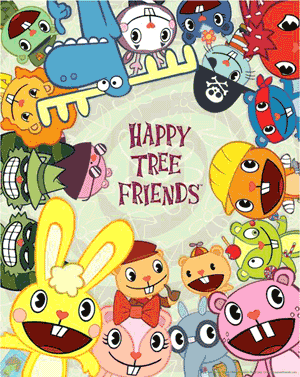



 Új bejegyzés
 Frissítés